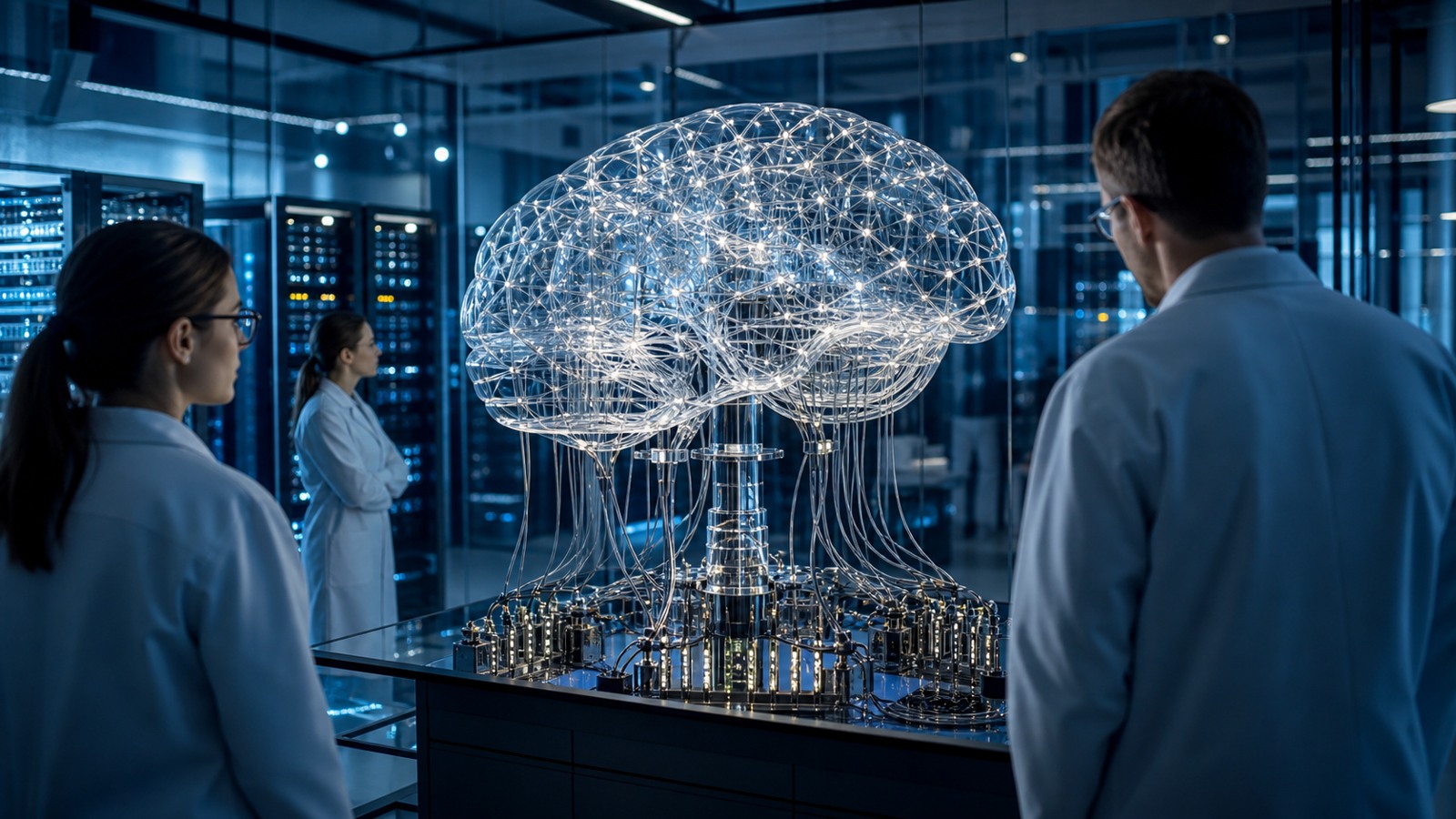
Deep Learning Turned Neural Networks Into the Engine of Modern AI
Deep learning is the branch of AI that uses large neural networks to learn patterns from data, and its rise explains much of modern artificial intelligence. The idea is older than many people realize, but it needed the right mix of algorithms, data, computing power, and engineering culture to become practical. Early neural networks were limited and controversial. Modern networks power speech recognition, image analysis, translation, recommendation systems, coding assistants, generative AI, scientific models, and multimodal agents. The history of deep learning is the story of a persistent idea finally meeting the conditions it needed to scale, then becoming reliable enough for products, labs, and everyday workflows. Its evolution also shows why modern AI is an infrastructure story, not only an algorithm story, shaped by hardware, benchmarks, data pipelines, research culture, and user demand moving together across decades of trial, frustration, and practical engineering.
A: It is about using AI to improve pattern learning, classification, generation, optimization, and prediction while keeping review and context in place.
A: No. Outputs need testing, source checks, and human judgment.
A: Common risks include overfitting, weak evaluation, hidden bias, and brittle generalization.
A: The most important data is the data that matches the real task and user decision.
A: No. Prompts help, but data quality, tool design, and review matter too.
A: Humans should stay involved when outcomes affect people, money, safety, privacy, or trust.
A: Test outputs against real examples, track errors, and measure whether the workflow improves.
A: Yes. Fluency is not proof of accuracy.
A: Clear goals, good data, review points, monitoring, and a fallback plan.
A: Accountability stays with builders who test limits instead of trusting demos.
The Old Idea Behind a Modern Revolution
Neural networks began with a simple ambition: build systems that learn from examples instead of relying only on hand-written rules. Early artificial neurons were crude, but the idea was powerful. If intelligence could be represented as many small units connected together, perhaps a machine could learn patterns by adjusting those connections.
For decades, that idea moved through cycles of excitement and disappointment. Early networks could solve limited problems, but they struggled with complexity. Computers were slow, datasets were small, and training deeper networks was unreliable. Other machine learning methods often looked more practical.
Deep learning did not succeed because the core metaphor suddenly changed. It succeeded because the surrounding conditions changed. Researchers found better training methods. The internet produced enormous datasets. GPUs made large-scale computation affordable. Benchmarks gave the field common targets. Industry discovered that neural networks could solve valuable problems.
That combination turned neural networks from an interesting research tradition into the foundation of modern AI. The shift was gradual, then suddenly visible. Speech recognition improved, image classification jumped forward, translation became more fluent, and generative systems began producing text, images, code, and audio.
Backpropagation Made Learning Practical
One of the most important steps was backpropagation, a method for adjusting the weights inside a neural network based on its errors. The network makes a prediction, compares it with the desired answer, calculates how much each connection contributed to the error, and updates those connections. Repeated many times, this process lets the system learn useful internal representations.
Backpropagation matters because multi-layer networks need a way to learn features automatically. A shallow model may require humans to design the right inputs. A deeper model can learn simple patterns in early layers and more abstract patterns in later layers. In vision, early layers may detect edges while later layers recognize objects. In language, layers may represent grammar, meaning, style, and context.
Training still required many supporting improvements. Better activation functions, initialization methods, normalization, regularization, and optimization helped deep networks avoid instability. The history of deep learning is full of these engineering details. They may sound less exciting than model demos, but without them the revolution would not have worked.
ImageNet and the Computer Vision Breakthrough
The public turning point for many observers came through computer vision. ImageNet, a large labeled image dataset and competition, gave researchers a way to compare methods on a common challenge. When deep convolutional networks dramatically improved image classification performance, the field took notice. Neural networks were no longer a fringe bet. They were beating established approaches.
Convolutional neural networks were especially suited to images because they could learn spatial features. Instead of treating every pixel independently, they used filters that detected patterns across small regions and built more complex representations layer by layer. This made them powerful for object recognition, medical imaging, defect detection, facial analysis, satellite imagery, and many other visual tasks.
The lesson extended beyond vision. With enough data, compute, and the right architecture, neural networks could learn representations that humans did not manually design. That principle became the engine behind progress in speech, language, recommendation, robotics, and science.
The ImageNet era also showed the importance of shared benchmarks. Benchmarks are imperfect, but they focus research. They let teams see whether progress is real, and they create competitive pressure to improve methods. Deep learning advanced partly because the field had measurable goals.
This benchmark culture also changed expectations for AI claims. Researchers could no longer rely only on elegant theory or narrow demonstrations. They had to show measurable improvements against other teams, which helped turn neural networks into an engineering race as well as a scientific project.
From Sequences to Transformers
Language and sequence modeling had their own path. Recurrent neural networks and related architectures were designed to handle ordered data, such as words in a sentence or frames in audio. They helped with translation, speech, and text generation, but they struggled with long-range dependencies and training efficiency.
Transformers changed the landscape by using attention. Attention lets a model weigh relationships between different parts of an input, such as which words in a sentence matter to one another. This made it easier to model long contexts and train large networks in parallel. Transformers became the backbone of modern language models and later expanded into images, audio, video, biology, and multimodal systems.
The transformer breakthrough was not only architectural. It aligned perfectly with scale. Models could be trained on vast datasets using huge compute clusters, then adapted for many tasks. This led to foundation models: large systems trained broadly and reused through prompting, fine-tuning, retrieval, and tool use.
Once language models became strong enough, AI felt different to the public. People could talk to the system directly. The interface became conversation, not code. That made deep learning visible in a way earlier recommendation engines and image classifiers were not.
Generative AI Expanded What Neural Networks Could Produce
Deep learning first became famous for recognizing patterns. Generative AI made it famous for creating outputs. Generative adversarial networks, diffusion models, autoregressive language models, and other approaches showed that neural networks could produce images, text, audio, video, code, and design options that felt startlingly fluent.
This changed the relationship between AI and creative work. Designers could explore visual directions faster. Writers could draft and revise. Musicians could experiment with sound. Marketers could generate variations. Engineers could prototype code. The value was not that AI replaced taste or judgment. It multiplied the number of possibilities people could inspect.
Generative AI also raised difficult questions. Who owns training data? How should creators be compensated? How do people detect synthetic media? What happens when spam, misinformation, or low-quality content becomes cheap? Deep learning’s creative power made governance and provenance urgent.
The public experience of AI also shifted. A person did not need to understand classifiers, embeddings, or gradient descent to feel the impact. They could type a request and receive a draft, a picture, a plan, or a piece of code. That immediate feedback made neural networks part of everyday culture.
Yet generation is still not the same as truth. A model can produce a compelling answer from statistical patterns without grounding every claim. That is why modern deep learning needs retrieval, verification, tool use, human review, and clearer signals about uncertainty.
This is the tension at the center of generative systems. They make expression easier, but they also make evaluation more important. The people who use deep learning well learn to ask not only whether the output looks good, but whether it is accurate, lawful, useful, and aligned with the task.
Deep Learning Moved Into Science and Industry
Modern neural networks now support science directly. Protein structure prediction, molecular generation, materials discovery, weather modeling, medical imaging, and laboratory automation all use deep learning methods. These applications are different from consumer chatbots. They require validation against physical reality and domain expertise.
Industry uses deep learning in quieter ways too. Fraud detection, recommendation, search ranking, speech transcription, translation, demand forecasting, document processing, cybersecurity, and predictive maintenance all rely on learned patterns. In many companies, deep learning is already part of the operational background.
The rise of deep learning also changed software development. Instead of writing every rule, engineers define objectives, curate data, train models, evaluate behavior, and monitor deployment. This is a different craft. It blends statistics, infrastructure, product design, ethics, and domain knowledge.
The Limits That Still Matter
Deep learning remains powerful but imperfect. Models can fail when the world changes, when data is biased, when prompts are adversarial, or when tasks require grounded causal understanding. A system may produce a plausible answer without knowing whether it is true. It may perform well on a benchmark and poorly in an actual workflow.
Interpretability is a major challenge. Neural networks learn internal representations that are difficult to translate into simple human rules. Researchers can inspect activations, features, circuits, and attention patterns, but full understanding remains limited. This matters more as models enter high-stakes domains.
Cost is another limit. Training and running large models requires energy, chips, cooling, networking, and money. Efficiency improvements are happening, but demand is rising too. The future of deep learning depends on hardware, algorithms, data quality, and economic sustainability.
The data problem is equally important. More data is not always better if it is low quality, unauthorized, biased, duplicated, or irrelevant. The next stage of deep learning may depend less on raw scale and more on better data, better feedback, better evaluation, and better integration with tools and environments.
What Comes After Modern Neural Networks
Deep learning will keep evolving. Future systems may combine neural networks with symbolic reasoning, retrieval, simulation, robotics, memory, causal models, and tool-based agents. Some researchers expect continued scaling to produce new abilities. Others expect architectural changes to matter more. Both forces will likely shape the field.
One important direction is smaller, specialized models. Not every task needs a giant general model. Efficient models running on devices, inside companies, or within regulated environments may become more common. Another direction is multimodal agency: systems that can understand many inputs and act through tools with supervision.
The central lesson from deep learning’s history is patience with old ideas and discipline with new claims. Neural networks seemed limited for decades, then became transformative when conditions changed. Today’s limits may also shift. But progress will depend on evidence, engineering, safety, and usefulness, not slogans.
Deep learning rose because it gave machines a way to learn representations from data at scale. That achievement reshaped AI. Whatever comes next will probably build on it, challenge it, and reveal again that intelligence is not a single trick but a stack of ideas made practical over time.
For beginners, the simplest takeaway is that modern AI is less a sudden invention than an accumulated stack. Mathematical ideas, datasets, chips, software libraries, benchmarks, and product needs all converged. That is why deep learning feels revolutionary now, even though its roots are old.
It also explains why the field keeps changing. When one layer improves, such as chips, datasets, evaluation, or model architecture, the whole stack can shift. Deep learning is not finished; it is an evolving foundation that keeps absorbing new techniques.
How Deep Learning Became Modern AI Infrastructure
Deep learning evolved from neural-network research into the backbone of modern AI because multilayer models became trainable at scale. Better algorithms, large datasets, GPUs, cloud infrastructure, open-source frameworks, transformers, and large-scale pretraining turned deep learning into a practical engine for vision, speech, language, recommendations, robotics, scientific modeling, and generative AI.
The path includes convolutional networks for images, recurrent and LSTM models for sequences, AlexNet’s ImageNet moment, attention mechanisms, transformers, BERT, GPT-style language models, diffusion models, and multimodal systems. IBM describes deep learning as machine learning driven by multilayer neural networks, which is why it now sits underneath so many AI products people use every day.