AI Robots Are Leaving the Lab Through Practical Jobs First
AI robots in 2026 are advancing quickly, but the most important story is practical deployment rather than science fiction. Robots are getting better at seeing their surroundings, learning from demonstrations, planning movements, coordinating with fleets, and adapting to environments that are not perfectly scripted. Humanoids receive the most attention, yet many real gains are happening in warehouses, factories, hospitals, farms, inspection sites, and delivery operations. The future of robotics is not one machine that does everything. It is a growing family of AI-powered systems built around specific physical work and measurable reliability.
A: It is about using AI to improve automation, triage, optimization, detection, and decision support while keeping review and context in place.
A: No. Outputs need testing, source checks, and human judgment.
A: Common risks include workflow mismatch, hidden errors, compliance gaps, and weak measurement.
A: The most important data is the data that matches the real task and user decision.
A: No. Prompts help, but data quality, tool design, and review matter too.
A: Humans should stay involved when outcomes affect people, money, safety, privacy, or trust.
A: Test outputs against real examples, track errors, and measure whether the workflow improves.
A: Yes. Fluency is not proof of accuracy.
A: Clear goals, good data, review points, monitoring, and a fallback plan.
A: Accountability stays with domain experts who judge outputs in context.
Why Robotics Is Entering a New Phase
Robotics has always promised machines that can take on physical work, but the older model was often rigid. Traditional industrial robots were excellent at repeating a controlled motion in a fenced area. They were less useful when objects varied, people moved nearby, or the environment changed. AI is changing that by improving perception, learning, planning, and adaptation.
The new phase is not magic autonomy. It is practical flexibility. A warehouse robot that can reroute around a blocked aisle, a factory system that can detect defects visually, or a farm robot that can distinguish weeds from crops is more valuable than a machine that only repeats a script. AI gives robots a better chance to interpret the world around them.
This shift explains why robotics feels hot again in 2026. Better models, cheaper sensors, stronger simulation, improved batteries, and large robotics datasets are all pushing the field forward. At the same time, labor shortages, supply-chain pressure, and demand for faster fulfillment make automation financially attractive.
The commercial mood has changed too. Buyers are less impressed by experimental autonomy and more focused on deployment metrics. They want to know how often the robot works, how quickly it can be serviced, how easily employees can intervene, and whether it improves the operation after the pilot team leaves.
The Breakthroughs Behind AI Robots
The first breakthrough is perception. Robots need to understand where they are, what objects are present, how those objects are shaped, and where people may move next. Advances in computer vision, depth sensing, multimodal models, and real-time processing make that easier. A robot does not need human-level understanding to be useful. It needs enough situational awareness to act safely and complete the task.
The second breakthrough is learning from demonstration. Instead of programming every motion by hand, engineers can show robots examples through teleoperation, video, simulation, or human-guided movement. The robot can then learn patterns that generalize to similar situations. This reduces setup time and makes robotics more adaptable.
The third breakthrough is simulation. Robots can practice in virtual environments where failures are cheap. Simulation can generate unusual scenarios, test policies, and train systems before real hardware is exposed to risk. The gap between simulation and reality remains a challenge, but the approach has become central to robotics progress.
The fourth breakthrough is language and interface design. Workers increasingly need to instruct robots without becoming robotics engineers. Natural language, visual prompts, and simple task interfaces can make robots easier to deploy. The interface is not a small detail; adoption often depends on whether people can work with the machine comfortably.
A fifth breakthrough is fleet intelligence. One robot can be useful, but many robots working together require traffic management, shared maps, charging schedules, task assignment, and exception handling. AI helps coordinate the group so the system behaves like an operation rather than a collection of isolated machines.
Humanoids Get Attention, Specialized Robots Get Work
Humanoid robots attract attention because they look like the future. The argument for them is practical: homes, offices, factories, and tools were built around human bodies. A humanoid could theoretically climb stairs, open doors, carry objects, use existing equipment, and move through human spaces without redesigning everything. That flexibility is valuable if it becomes reliable.
The engineering challenge is severe. Walking is energy-intensive. Hands are complex. Balance must be constant. Safety near people is non-negotiable. Battery life limits duty cycles. Costs must fall. A humanoid that performs a perfect demo for ten minutes may still be far from a machine that works eight hours in a busy facility.
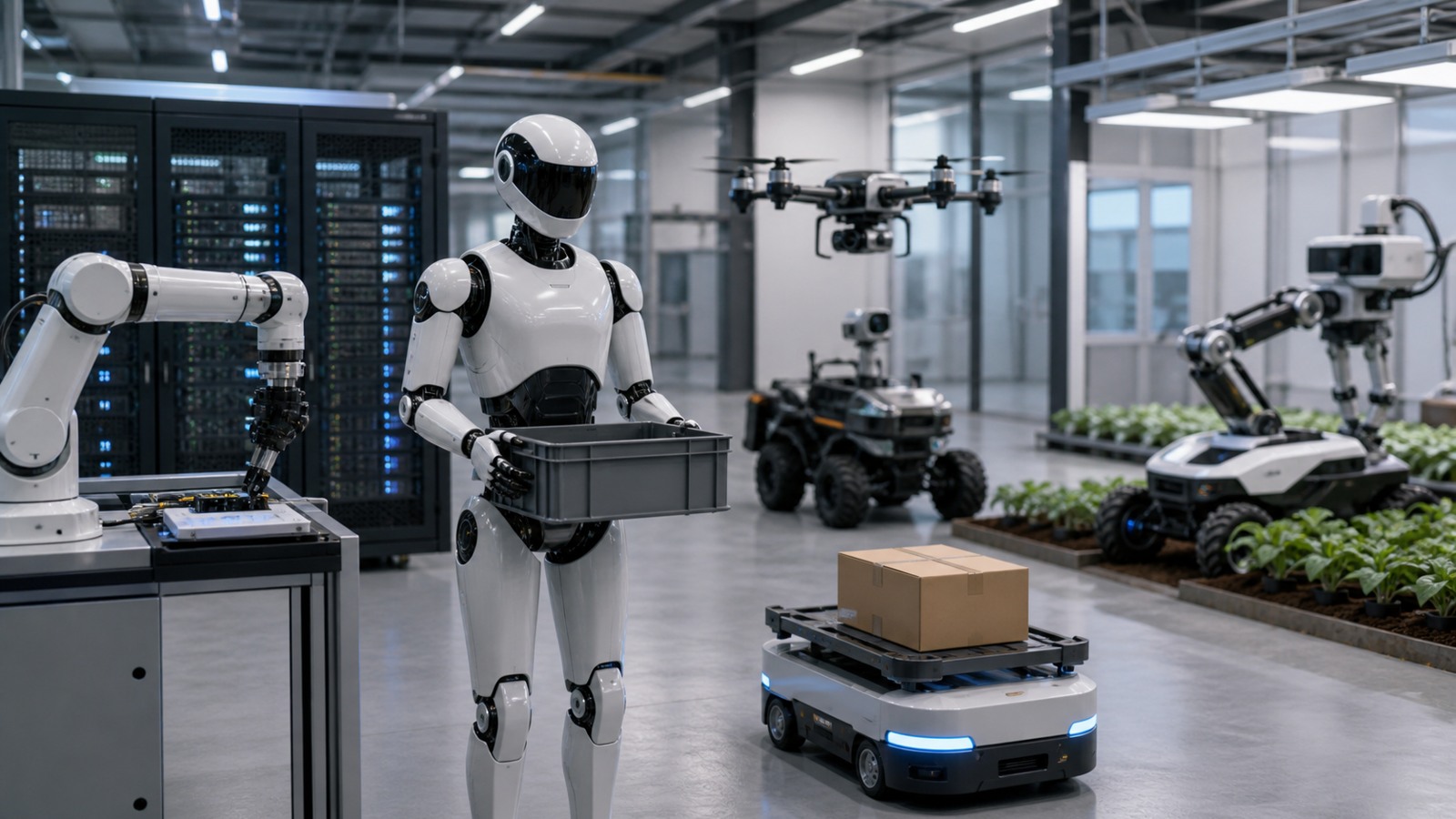
Specialized robots often win because they do not need to imitate people. A wheeled warehouse robot can move goods efficiently. A surgical robot can provide precision. A drone can inspect a tower. A farm robot can move through rows of crops. These machines may look less dramatic, but they are designed around the job.
The likely near-term picture is mixed. Humanoids will be tested in structured environments where flexibility matters, while specialized robots continue expanding in places where the workflow is clear. The real question is not which robot looks most advanced. It is which robot delivers measurable value safely.
Where AI Robots Are Used Now
Logistics and warehousing remain leading use cases. Robots can move shelves, sort packages, scan inventory, transport totes, and help workers avoid long walking routes. AI improves routing, object recognition, and fleet coordination. Because warehouses have measurable throughput, automation value is easier to calculate.
Manufacturing is another major area. AI robots can inspect products, handle variable parts, assist with assembly, and support predictive maintenance. Modern factories need flexibility as product lines change. Robots that can adapt to variation are more useful than machines locked into one motion forever.
Healthcare uses robots more carefully, but the potential is large. Hospital delivery robots can move supplies. Surgical systems can assist trained clinicians. Rehabilitation and assistive robots can support mobility. The stakes are high, so adoption depends on validation, safety, and trust.
Agriculture, construction, cleaning, security, and inspection are also growing. Many of these jobs involve repetitive movement, hazardous conditions, or environments where staffing is difficult. Robots can extend human reach, but they must survive weather, dust, uneven surfaces, poor connectivity, and unexpected obstacles.
Home robots remain harder than people expect. Homes are cluttered, varied, intimate, and full of objects that change location. A robot in a warehouse may know where shelves belong. A home robot must handle toys, pets, spills, stairs, furniture, cables, and personal preferences. That level of generality is still difficult.
The Role of Data in Physical AI
AI robots need data about action, not only words or images. They need to learn how objects feel, how weight shifts, how wheels slip, how arms collide, how doors resist, and how people move nearby. This makes robotics data expensive. A language model can learn from huge text collections, but a robot needs examples of physical interaction.
Teleoperation is one way to gather that data. A human remotely controls the robot while the system records observations and actions. Over time, the robot learns from those demonstrations. Video data, simulation, and shared robotics datasets can also help. Each source has limits, so practical systems often combine them.
Data quality matters more than raw volume. A robot trained only in clean demonstrations may fail when an object is partly hidden or a person interrupts the task. Training data must include ordinary messiness. Safety data is especially important because rare mistakes can be serious.
Robotics also benefits from fleet learning. If many robots encounter different situations, lessons from one machine can improve others. That creates a powerful feedback loop, but it also raises questions about privacy, security, and who controls the data gathered in shared spaces.
Safety and Trust Decide Adoption
A software error can be fixed with a patch. A robot error can hit a person, damage equipment, spill chemicals, block an exit, or stop a production line. That physical reality makes robotics safety different from ordinary software safety. Robots need sensors, emergency stops, speed limits, safe zones, monitoring, and clear procedures for human intervention.
Trust also depends on predictability. Workers need to know what the robot will do, how to pause it, and when it needs help. A machine that behaves strangely may be technically advanced but operationally unacceptable. Good robotics design makes the robot’s state and intention legible.
Security is part of safety. Connected robots may have cameras, microphones, maps, facility data, and control systems. A compromised robot could expose sensitive information or disrupt operations. Buyers should treat robotics security as seriously as network security.
How Companies Should Evaluate AI Robots
Companies should start with the task, not the technology. What work is repetitive, risky, hard to staff, or expensive to delay? What environment will the robot face? How often do objects vary? How close will people be? What happens if the robot stops? These questions determine whether automation makes sense.
A pilot should measure more than speed. Uptime, maintenance, worker acceptance, integration, safety incidents, exception handling, and total cost all matter. A robot that works well in a vendor demo may struggle with a real floor layout, old software system, or unpredictable human traffic.
Workflow redesign is often the hidden work. If a warehouse changes packaging, aisle layout, scheduling, and worker roles to support robots, the project becomes organizational, not only technical. The best deployments involve employees early because they know where the real friction lives.
Leaders should also avoid using robots as symbols. A futuristic machine that does not solve a real problem becomes an expensive distraction. The most successful AI robots will often be boring in the best way: reliable, measurable, and integrated into work.
What AI Robots Mean for the Future
AI robots will expand first where environments are structured and the economics are clear. Warehouses, factories, farms, hospitals, labs, and inspection sites will keep adopting machines that can reduce risk, improve consistency, and support human teams. Over time, systems will become more flexible, easier to instruct, and more capable of handling exceptions.
Humanoids may become important if they can prove reliability and cost-effectiveness. The idea is compelling, but the market will demand results. A general-purpose robot has to earn its place by doing useful work, not by resembling a person. In many settings, the winning robot may have wheels, arms, sensors, and no human shape at all.
The social question is how robotics changes work. Good automation can reduce injuries, fill labor gaps, and let people focus on judgment-heavy tasks. Poor automation can deskill workers, increase surveillance, or shift risk without sharing benefits. The technology does not decide the outcome by itself.
In 2026, AI robots are best understood as practical physical AI entering more real environments. They are not yet universal household helpers. They are becoming capable coworkers in specific domains, and that is enough to transform logistics, manufacturing, care, agriculture, and inspection one workflow at a time.
The next few years will reward patience and measurement. The best robotics companies will make machines that can be repaired, monitored, updated, and trusted by ordinary teams. The best buyers will choose use cases where the robot improves safety or throughput without creating hidden complexity elsewhere.
That is a quieter future than the fantasy of instant robot servants, but it is more believable. The robots that matter most may be the ones people stop noticing because they simply keep the warehouse moving, the hospital supplied, the field monitored, or the dangerous inspection completed.