AI Creativity Works Best as a Partner for Human Taste
AI is enhancing human creativity across every industry by making it easier to explore ideas, generate variations, prototype quickly, research unfamiliar territory, and move from rough concept to polished draft. The point is not that machines suddenly have human imagination. The point is that AI can widen the creative field around a person or team, offering raw material that humans can judge, reshape, combine, and reject. In design studios, classrooms, labs, marketing teams, music workflows, product groups, and small businesses, AI is becoming a creative instrument rather than a complete creator. The strongest results come when people use that instrument with taste, purpose, and restraint.
A: It is about using AI to improve analysis, generation, automation, search, and decision support while keeping review and context in place.
A: No. Outputs need testing, source checks, and human judgment.
A: Common risks include inaccuracy, bias, privacy exposure, and overreliance.
A: The most important data is the data that matches the real task and user decision.
A: No. Prompts help, but data quality, tool design, and review matter too.
A: Humans should stay involved when outcomes affect people, money, safety, privacy, or trust.
A: Test outputs against real examples, track errors, and measure whether the workflow improves.
A: Yes. Fluency is not proof of accuracy.
A: Clear goals, good data, review points, monitoring, and a fallback plan.
A: Accountability stays with people who verify, govern, and apply the result.
Why AI Feels Creative Even When It Is Not Human
AI feels creative because it can produce unexpected combinations quickly. A person can ask for ten campaign ideas, five visual directions, three product names, a rough song structure, a lesson plan, or a prototype interface and receive usable starting points in seconds. That speed changes the emotional experience of creating. Instead of waiting for the first idea, the creator begins with a field of possibilities.
The system does not need a human inner life to be useful. It has learned patterns from text, images, code, sound, and other material, and it can recombine those patterns in response to instructions. The result may be surprising, helpful, or beautiful, but the meaning still depends on human selection and context. A generated image does not know the client, the audience, or the reason the project exists.
This is why AI creativity is best understood as augmentation. It extends reach, not responsibility. A designer can inspect more options. A writer can test different structures. A scientist can visualize an idea. A marketer can adapt a message for several audiences. The creative person still decides what is true, tasteful, useful, and worth sharing.
That distinction matters because it protects both optimism and craft. AI can genuinely help people make better work. It can also produce fluent mediocrity at scale. The difference is usually the human process around it.
The New Creative Workflow
In many industries, AI is becoming part of the earliest creative phase. Teams use it to explore, not to conclude. A product group may generate interface concepts before choosing one direction. An architecture studio may examine massing studies before committing to drawings. A filmmaker may storyboard a scene to understand pacing. A teacher may adapt one lesson into several formats before class.
The middle of the workflow is where AI often becomes most useful. Once a direction exists, the system can help create variations, check consistency, summarize research, rewrite for tone, or convert material into different formats. This is less glamorous than a fully generated masterpiece, but it saves real time. It lets creators spend more energy on decisions that require taste.
The final stage still needs people. Polished output can hide weak thinking, factual errors, unclear rights, or emotional flatness. Human review brings accountability. It asks whether the work serves the goal, respects the audience, and feels specific enough to matter.
Design, Media, and Entertainment
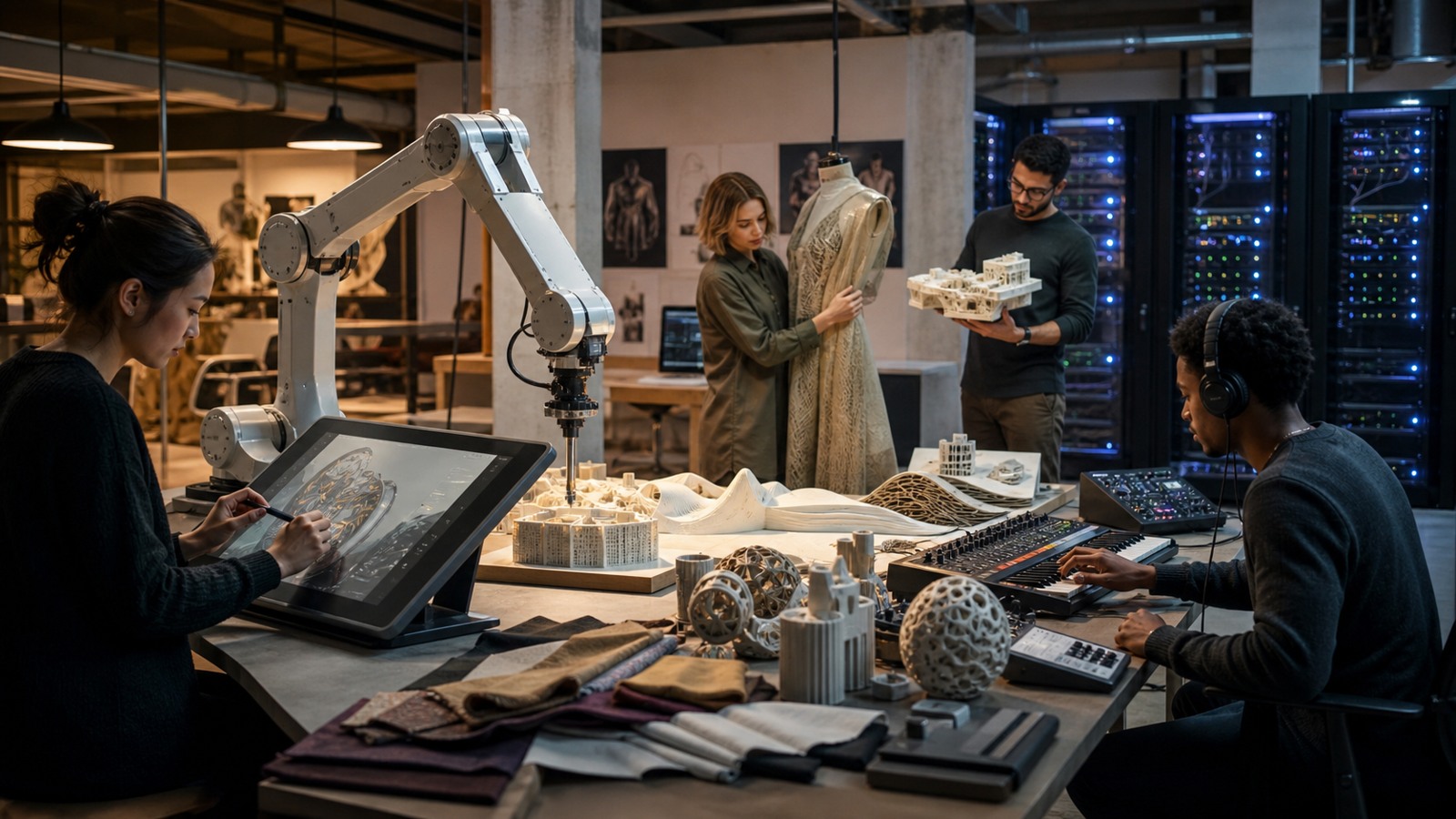
Design teams use AI to move faster through possibility. Interior designers can compare moods and materials. Brand teams can test color systems and visual metaphors. UX teams can prototype screen flows. Industrial designers can explore form factors. The advantage is not that AI knows the correct design. It helps people see what might be possible before narrowing the choice.
In film and video, AI can support concept art, storyboards, previs, editing assistance, localization, and visual experimentation. This can help independent creators compete with smaller budgets, but it also changes expectations. When rough visuals are easy, teams may need stronger discipline about what is actually production-ready.
Music and audio workflows are changing too. AI can create reference tracks, clean recordings, suggest harmonies, generate background textures, and help producers test arrangements. The strongest musicians will use these tools like instruments: not as replacements for taste, but as ways to hear more options.
Games may see some of the deepest creative integration. Characters, dialogue, environments, level concepts, testing scenarios, and personalization can all involve AI. The challenge is coherence. A game is not a pile of assets. It is an experience with rules, pacing, art direction, and player emotion. AI has to serve that whole.
Across entertainment, rights and disclosure will matter. Audiences may accept AI-assisted work when it is honest and good. They may reject work that feels derivative, exploitative, or deceptive. Creative industries will need norms that protect both experimentation and trust.
The same is true in publishing and advertising. AI can generate headline options, image directions, and audience versions, but a campaign still needs a point of view. The work that travels is usually the work that understands a real audience tension, not the work that merely produces many polished variations.
This is why creative directors, editors, producers, and art leads remain so important. AI can widen the menu, but leadership decides the meal. Someone still has to protect coherence, say no to attractive distractions, and make the work feel like it belongs to a specific project rather than a generic trend.
The same is true in publishing and advertising. AI can generate headline options, image directions, and audience versions, but a campaign still needs a point of view. The work that travels is usually the work that understands a real audience tension, not the work that merely produces many polished variations.
Business Creativity Is Not Just Art
Creativity in business often means finding a useful path through constraints. A sales team needs a clearer pitch. A founder needs a product story. A manager needs a training plan. A consultant needs a framework. A support leader needs better responses. AI helps by turning vague intention into drafts that can be examined and improved.
This makes AI especially useful for small teams. Work that once required a writer, designer, analyst, and strategist can now begin with one person using AI to prototype. That does not remove the need for expertise, but it lowers the cost of exploration. A small business can test website copy, ad concepts, email sequences, product descriptions, and customer FAQs without waiting weeks.
The danger is sameness. If every business asks similar tools for similar outputs, the public web fills with polished repetition. Brands that stand out will be the ones that use AI to accelerate thinking, then add lived customer knowledge, sharper positioning, and a voice that does not sound default.
AI also changes internal creativity. Employees who were not comfortable writing or designing from scratch may contribute more because the first draft barrier is lower. Good organizations will treat this as a literacy opportunity, teaching people how to prompt, critique, verify, and revise rather than simply asking for more content.
This is especially valuable in operational teams that rarely think of themselves as creative. A logistics manager designing a better shift handoff, a recruiter rewriting candidate communication, or a support lead reworking a knowledge base is doing creative problem-solving. AI helps those workers test language and structure without waiting for a specialist.
This is especially valuable in operational teams that rarely think of themselves as creative. A logistics manager designing a better shift handoff, a recruiter rewriting candidate communication, or a support lead reworking a knowledge base is doing creative problem-solving. AI helps those workers test language and structure without waiting for a specialist.
Science, Education, and Public Work
Scientific creativity is not only inspiration; it is the disciplined generation of testable ideas. AI can help researchers scan literature, connect findings, visualize systems, write code, suggest experimental designs, and explore possible explanations. The human scientist still has to judge whether a hypothesis is meaningful and whether evidence supports it.
Education may benefit because AI can help teachers adapt material. A lesson can be rewritten for different reading levels, connected to a student’s interests, turned into practice questions, or translated into another language. That supports creativity in teaching, but it also requires caution. Students need accurate material, privacy protection, and learning experiences that build skill rather than bypass it.
Public-sector creativity often means designing services under pressure. AI can help draft forms, explain policies, summarize public feedback, and model scenarios. Used well, it can make government communication clearer and more accessible. Used poorly, it can automate confusing systems without fixing them.
What Humans Still Do Better
Humans bring intention. A person can decide that a campaign should comfort rather than impress, that a classroom activity should build confidence, or that a design should feel quiet because the audience is overwhelmed. AI can generate options, but it does not care why one option is humane and another is merely clever.
Humans also bring context. A joke that works in one culture may fail in another. A visual reference may carry history the model does not understand. A persuasive phrase may be technically effective but ethically wrong. Creative work lives inside relationships, institutions, memories, and consequences.
Craft remains essential. Great work often depends on small decisions: the cut that changes a scene, the word that sharpens a sentence, the silence that makes music breathe, the proportion that makes a room feel calm. AI can propose, but craft chooses and refines.
Finally, humans bring accountability. When creative work affects voters, patients, students, workers, customers, or communities, somebody has to answer for it. AI cannot carry that responsibility. It can only be used by people who do.
The Ethics of AI-Assisted Creativity
AI-assisted creativity raises questions about training data, consent, ownership, credit, disclosure, and labor. If a model learns from creative work without permission, artists may feel their style and effort have been absorbed into a commercial system. If companies use AI to cut costs without supporting workers, creative industries may become less sustainable.
Disclosure is not always simple. Many tools already include AI features, from spellcheck to image enhancement. Still, audiences deserve clarity when AI materially shapes something they may evaluate differently, such as journalism, political media, medical communication, or synthetic performances. The more the work imitates reality or a specific person, the stronger the disclosure need becomes.
There is also a quality problem. When content becomes cheap, the world gets more of it. That can make it harder for careful work to be noticed. Creative teams may need to compete less on volume and more on trust, specificity, and real usefulness.
How to Use AI Without Losing Your Voice
The best creative AI workflow starts with a human brief. Define the purpose, audience, constraints, references, and emotional target before asking for output. Then use AI to explore multiple paths. Do not accept the first version because it is smooth. Smooth is not the same as right.
Creators should build a habit of contrast. Ask for a practical version, a surprising version, a restrained version, and a version that challenges the assumption. Comparing options sharpens judgment. It also keeps the model from steering the work toward the most common pattern.
The final move is deliberate editing. Remove generic phrasing, add real examples, check facts, respect rights, and make choices that reveal the creator’s point of view. AI can help produce material, but voice emerges from selection. The more intentional the selection, the more human the result feels.
AI is not the end of creativity. It is a new pressure on creativity. It rewards people who can think clearly, judge carefully, and bring lived context into the tool. Across industries, the winners will be creators who use AI to expand the possible without surrendering the personal.