Autonomous Systems Are AI-Driven Tools That Can Act
Autonomous systems are machines or software environments that can sense what is happening, make decisions, and take action with limited human direction. They range from warehouse robots and drones to driver-assistance systems, smart factories, energy controls, agricultural machines, and software agents that complete digital tasks. The word autonomous does not mean uncontrolled. It means the system has permission to make certain choices inside boundaries set by people. Understanding autonomous systems helps beginners see how AI moves from analysis into action, and why safety, oversight, and clear limits matter so much.
A: It observes its environment, evaluates options, and acts inside rules set by designers or operators.
A: It can, but only when the workflow gains perception, decision logic, adaptation, and meaningful safeguards.
A: No. Many systems are only autonomous for specific tasks or environments.
A: They are used in robots, vehicles, factories, farms, energy systems, logistics, and software.
A: AI helps interpret complex inputs, predict outcomes, and choose actions.
A: It should pause, ask for help, or move to a safe routine when the situation exceeds its tested limits.
A: Yes. People define goals, monitor performance, set limits, and stay accountable.
A: Teams underestimate exception handling, data quality, maintenance, and the need for human override.
A: Yes. Digital agents can act across workflows without moving through physical space.
A: Autonomy works best when capability is paired with testing, boundaries, and oversight.
A Simple Way to Understand Autonomy
Autonomy means a system can choose some actions for itself. That does not mean it has free will or human judgment. It means people have given the system a goal, information about the situation, and permission to make certain decisions without asking every time.
A basic automated system follows fixed instructions. If this happens, do that. An autonomous system can adapt when conditions change. A warehouse robot may reroute around an obstacle. A drone may adjust to wind. A software agent may gather missing information before completing a workflow.
Autonomy comes in degrees. Some systems only assist humans. Others act independently in narrow environments. Very few systems should be trusted everywhere. The right question is not whether a system is autonomous in general, but what it is allowed to decide, where it operates, and what happens when it is unsure. This is why operating domain matters so much. A machine can be reliable in a warehouse aisle and unsafe on a busy street, even if the underlying technology looks similar.
This framing helps beginners avoid hype. Autonomous systems are not magic minds. They are engineered systems that combine sensing, prediction, planning, control, and oversight.
It also explains why autonomy is useful before it is universal. A system can create value by doing one bounded job well, such as inspecting a pipeline, moving inventory, or organizing routine software work. It does not need to handle every possible situation to be worth using.
It also helps explain why autonomy is useful before it is perfect. A system does not need to handle every possible task to create value. It needs to handle a defined task reliably enough that people gain time, safety, consistency, or reach.
How Autonomous Systems Sense the World
Every autonomous system needs inputs. Physical machines may use cameras, radar, lidar, GPS, microphones, temperature sensors, pressure readings, or motion sensors. Digital systems may use documents, databases, logs, calendars, messages, or software events.
The system must turn those inputs into a useful understanding of the situation. A vehicle needs to identify lanes, pedestrians, signs, and nearby movement. A factory robot needs to know where a part is and whether it is safe to move. A software agent needs to know which file, customer record, or task it is handling.
Sensing is difficult because the world is messy. Lighting changes, sensors fail, data arrives late, people behave unexpectedly, and environments drift over time. A system that works in a controlled demo may face surprises in ordinary use.
Good design often uses multiple signals. If one sensor is uncertain, another may help. If two inputs disagree, the system can slow down or ask for help. Sensing is the foundation of safe autonomy because a system cannot act well if it misunderstands the situation. This is true for software too. A digital agent should verify permissions, data sources, and task context before it changes records or sends messages.
How AI Helps With Decisions
AI helps autonomous systems interpret complex inputs and predict what may happen next. A model may classify an object, estimate demand, detect a fault, forecast movement, or decide which cases need attention. This is where autonomy becomes more flexible than ordinary automation.
Decision-making usually has layers. Perception asks what is happening. Prediction asks what may happen soon. Planning asks what action best fits the goal and constraints. Control executes the action. Monitoring checks whether the action worked.
The model does not decide values on its own. People define the goal and constraints. A delivery robot should avoid people, follow local rules, protect the package, and preserve battery. A software agent should respect permissions, privacy, and approval steps. AI helps choose actions inside those human-defined boundaries. If the boundaries are vague, the system may optimize for speed or completion in ways that create new problems.
Uncertainty is central. When confidence drops, the system should not pretend everything is fine. It should slow down, choose a safer option, request review, or stop. Safe autonomy depends on knowing when not to act.
This is one of the biggest differences between a demo and a deployment. A demo often shows what the system can do when conditions are favorable. Deployment asks what the system does when sensors disagree, people behave unexpectedly, or a task falls outside the original design.
Physical and Digital Examples
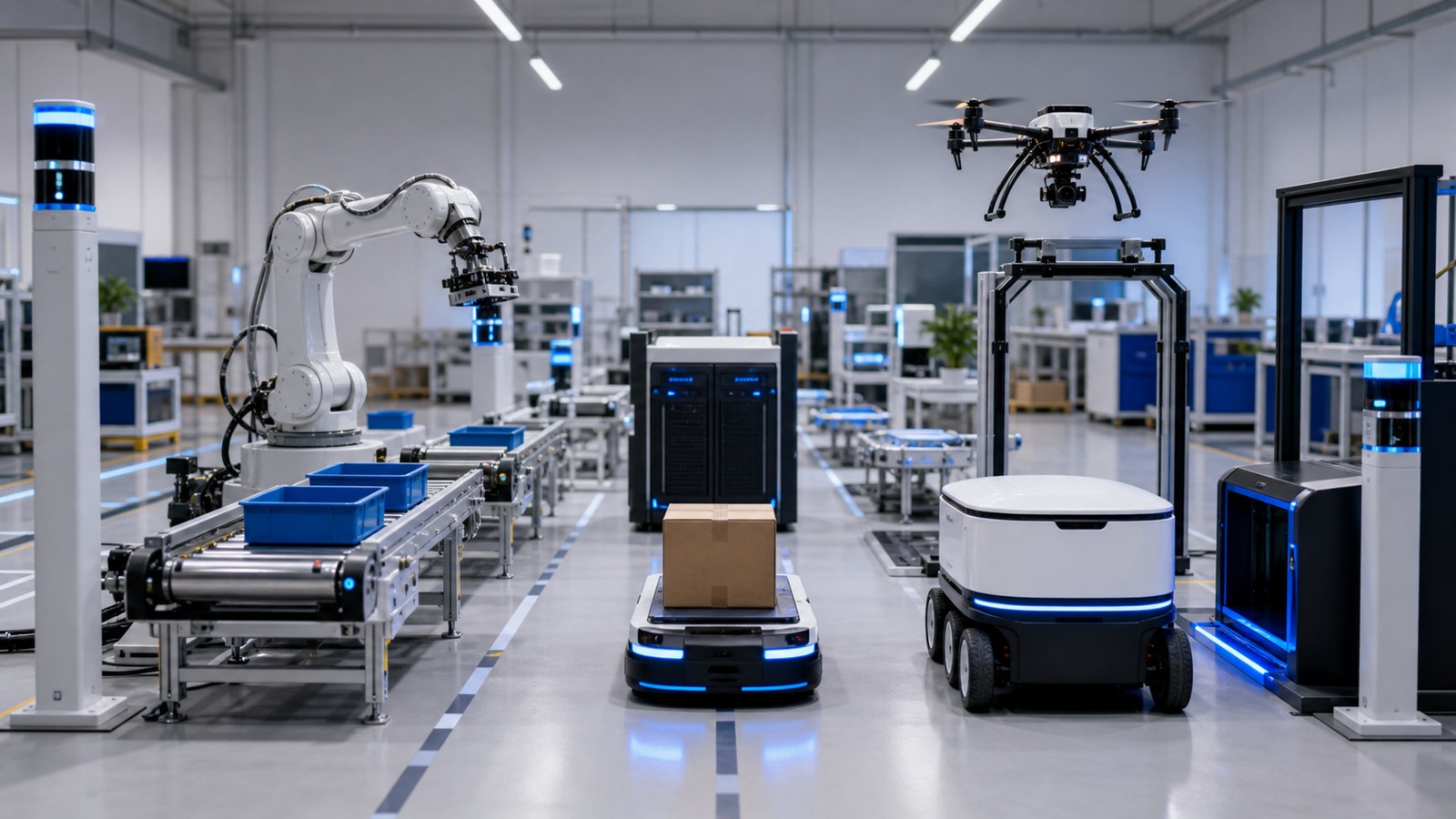
Robots are the most visible examples. Warehouse robots move goods, hospital robots deliver supplies, agricultural machines monitor fields, and inspection drones reach places that are dangerous or expensive for humans. These systems combine sensors with movement.
Vehicles use autonomy in different degrees. Driver-assistance features can help with braking, lane keeping, parking, or traffic awareness. More advanced systems attempt broader driving tasks, but roads are complex social environments. Safety requires careful limits and monitoring.
Factories use autonomous systems to improve precision and flexibility. A robot arm may adjust to small differences in parts. A production system may route work around a bottleneck. A maintenance model may warn that equipment is drifting toward failure.
Digital autonomy is growing quickly. Software agents can gather information, summarize updates, create drafts, update tickets, or move work through a process. They do not move through physical space, but they still act. That means they need permissions, logs, and oversight.
The common thread is action under constraints. Whether the system moves a robot or updates a file, autonomy becomes important when AI output changes the world in some way. The more consequential the action, the more the system needs approval paths, monitoring, and recovery plans.
Beginners should pay attention to the action, not only the intelligence. A system that merely suggests a step can be reviewed slowly. A system that takes the step needs stronger boundaries because the cost of correction may be higher.
Why Safety Is the Central Challenge
Autonomous systems are exciting because they can act without waiting for constant instruction. That is also why they can be risky. A recommendation can be ignored, but a machine action may be immediate. A software agent can make many changes quickly. A small error can scale.
Safety begins with defining the operating domain. Where may the system work? What conditions are allowed? What tasks are out of scope? A robot designed for a warehouse should not be assumed safe on a sidewalk. A digital agent designed for draft updates should not be allowed to send final legal notices. Clear boundaries prevent teams from quietly expanding autonomy beyond what has been tested.
Testing should include messy cases, not only normal ones. What happens when sensors disagree, a person blocks the path, a network connection fails, or a user gives a confusing instruction? The system's behavior under stress matters more than its best demo.
Human intervention should be practical. If operators cannot understand alerts, pause the system, or recover from failures, oversight is weak. Safety is a complete workflow, not a button labeled human in the loop.
Practical intervention also depends on timing. A person cannot responsibly supervise a fast-moving system if the warning arrives after the action is complete. Good autonomy design gives humans enough context and enough time to matter.
The Role of Human Oversight
Humans remain responsible for autonomous systems. People choose the use case, set permissions, define success, monitor performance, and respond to failures. The more impact a system can have, the stronger the oversight should be.
Good oversight is calibrated. Low-risk routine actions may be allowed automatically. High-risk actions may require approval. Unusual situations may trigger escalation. The goal is not to review everything manually, but to review the decisions where human judgment matters most.
Interfaces shape oversight. Operators need to know what the system is doing, why it is doing it, and when confidence is low. A dashboard that hides uncertainty encourages overtrust. A clear interface helps people intervene before small problems become serious. Alerts should be rare enough to deserve attention and specific enough to support action. Otherwise people may learn to ignore the very signals meant to keep the system safe.
Training matters too. Users need to understand the system's limits, not only its features. They should know when to trust it, when to question it, and how to report problems. Autonomous systems become safer when people around them understand their role. Training should include examples of failure, not only successful use, because people need to recognize the moments when automation should stop.
How Organizations Should Adopt Autonomy
Organizations should begin with a narrow, well-defined task. Instead of asking where can we add autonomy, they should ask which decision or process would genuinely improve if the system could adapt within boundaries. Clarity prevents unnecessary risk.
A pilot environment is useful. Teams can test performance, watch operator behavior, identify edge cases, and refine safety rules before scaling. Early limits are not a sign of failure. They are how trust is earned.
Measurement should include more than speed. Did quality improve? Did errors drop? Did humans understand the system? Did incidents become easier to investigate? Did the system create new risks or shift work onto people in hidden ways?
Adoption also requires maintenance. Sensors drift, models age, software changes, and environments evolve. Autonomous systems need updates, audits, and incident reviews. A system that was safe at launch may need adjustment later. Teams should treat autonomy like infrastructure that requires care over time, not like a feature that can be switched on and forgotten.
This maintenance mindset is especially important when autonomy crosses from pilot to production. More users, more environments, and more edge cases can reveal weaknesses that did not appear in early testing. Scaling should follow evidence, not excitement.
What Beginners Should Remember
Autonomous systems are best understood as AI-driven action under human-defined limits. They sense, decide, and act, but they do not replace responsibility. People still define the purpose and remain accountable for outcomes.
The promise is real. Autonomous systems can reduce repetitive work, improve timing, reach dangerous places, optimize resources, and help software workflows move faster. They can make operations smoother when the task is well chosen.
The risk is also real. Messy environments, bad data, unclear permissions, overtrust, weak oversight, and poor maintenance can turn autonomy into a liability. The safest systems are the ones that know their boundaries.
For beginners, the key lesson is balance. AI-driven automation is powerful when it adapts to the world, but it becomes trustworthy only when people design clear limits, test carefully, and stay ready to intervene. The best autonomous systems are not the ones that promise independence everywhere. They are the ones that perform a defined job well, admit uncertainty, and hand control back when the situation calls for human judgment. That balance is what makes autonomy practical rather than theatrical, especially in everyday operations where reliability matters most over time and at scale for users and teams alike.