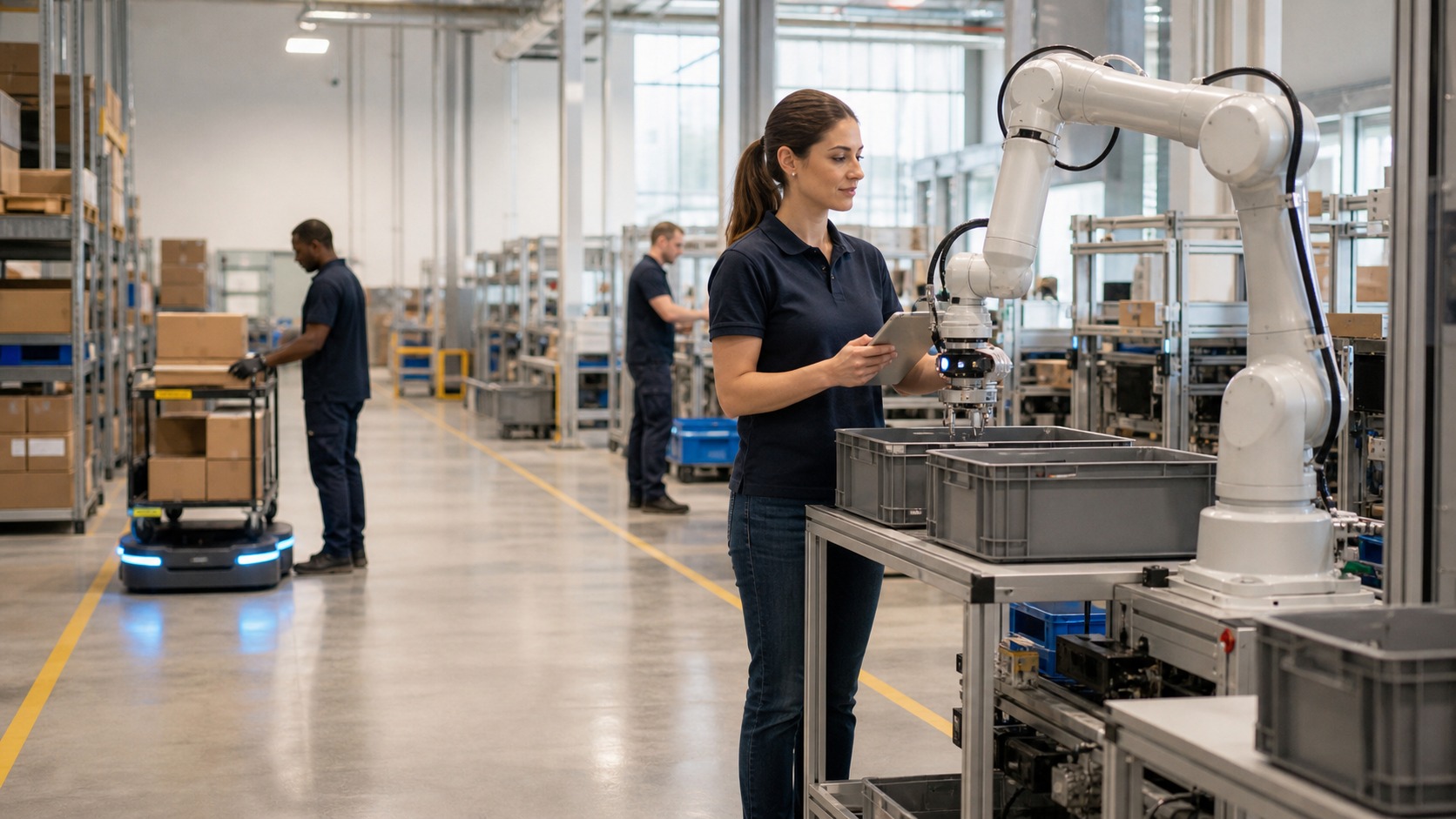
Autonomy Is Becoming An Operating Layer
The future of autonomous systems will not be defined by one spectacular robot or one perfectly self-driving vehicle. It will be defined by many smaller systems that sense the world, make limited decisions, coordinate with other machines, and hand difficult cases back to people. The next decade is likely to move autonomy from isolated pilots into supervised fleets, industrial sites, hospitals, farms, logistics networks, energy infrastructure, and public spaces. The most important trend is not machines acting alone. It is autonomy becoming an operating layer that helps physical systems adapt while staying inside rules humans can inspect and govern.
A: It is about using AI to improve forecasting, ranking, scoring, and decision support while keeping review and context in place.
A: No. Outputs need testing, source checks, and human judgment.
A: Common risks include bad assumptions, stale data, and overconfident forecasts.
A: The most important data is the data that matches the real task and user decision.
A: No. Prompts help, but data quality, tool design, and review matter too.
A: Humans should stay involved when outcomes affect people, money, safety, privacy, or trust.
A: Test outputs against real examples, track errors, and measure whether the workflow improves.
A: Yes. Fluency is not proof of accuracy.
A: Clear goals, good data, review points, monitoring, and a fallback plan.
A: Accountability stays with analysts who test the pattern before acting on it.
The Next Decade Will Reward Narrow Autonomy
The most realistic future for autonomous systems is not a sudden leap into machines that can handle every environment without help. It is a steady expansion of narrow autonomy: systems that perform defined jobs in defined conditions and become gradually more capable as evidence accumulates. A delivery robot may master a campus before navigating a city. An autonomous forklift may succeed inside a mapped warehouse before operating in a chaotic outdoor yard. A farming robot may handle one crop, season, or terrain type before expanding.
This matters because autonomy is physical. A wrong recommendation in software can be corrected after review, but a wrong movement can block a hallway, damage equipment, delay a shipment, or injure someone. The next decade will reward companies that define operating limits clearly and prove performance under real conditions. The flashy question is whether machines can act alone. The practical question is where they can act safely enough to earn more responsibility.
Narrow autonomy also creates a learning path. Each bounded deployment produces data about routes, interventions, weather, human behavior, maintenance, and failure modes. That data can improve the next deployment without pretending one model will instantly generalize everywhere. Autonomy grows by accumulation, not by magic.
This is why many of the strongest deployments will sound modest at first. A campus shuttle that handles a fixed loop, a robot that moves lab samples, or an inspection drone that checks one kind of asset may not look revolutionary. Yet these systems build the evidence base for broader autonomy. They show how people react, what maintenance actually costs, where edge cases appear, and which rules must be rewritten before machines can safely do more.
Fleet Supervision Will Become A Core Model
One of the most important trends is the move from single autonomous machines to supervised fleets. A company does not want one smart delivery robot, one inspection drone, or one autonomous cart. It wants a coordinated group of machines that can share maps, report problems, divide tasks, and escalate exceptions to trained operators. This turns autonomy into an operations discipline.
Fleet supervision changes the economics. A human may not need to drive every robot, but they may oversee many machines, respond to alerts, approve unusual decisions, and analyze recurring failures. That role is not passive. The supervisor needs domain knowledge, system knowledge, and authority to pause or improve the workflow. If organizations treat supervision as a low-skill monitoring job, they will miss many of the benefits.
The fleet model also makes safety more scalable. Instead of every machine learning in isolation, one incident can inform the whole network. A blocked route, risky behavior pattern, or sensor problem can trigger updates across similar sites. The challenge is governance: teams need to know which version is running, what changed, and whether the change was validated.
Edge AI Will Move More Decisions Closer To Machines
Autonomous systems cannot depend on distant servers for every urgent decision. A robot approaching a person, a drone correcting its path, or an industrial vehicle detecting an obstacle needs local processing. Edge AI moves perception, planning, and safety checks closer to the machine, reducing latency and making autonomy more resilient when connectivity is weak.
This does not mean the cloud disappears. Cloud systems will still support fleet learning, heavy simulation, reporting, model updates, and long-term analytics. The future is a split architecture: immediate safety decisions happen locally, while broader learning and coordination happen across the network. Getting that split right will be a major engineering challenge.
Edge autonomy also raises security and maintenance issues. Devices in the field need updates, monitoring, calibration, and protection against tampering. A compromised autonomous machine is not only a data risk. It can become a physical risk. The next decade will force security teams and robotics teams to work much more closely.
The edge trend will also change hardware design. Machines will need processors that can run perception models efficiently without overheating, draining batteries, or relying on constant network access. That will push autonomy toward better chips, better compression, and smarter division of labor between local devices and shared systems. The future autonomous machine will be judged not only by how well it sees, but by how reliably it thinks under power, heat, cost, and latency constraints.
Simulation Will Become The Proving Ground
Real-world testing is necessary, but it cannot cover every rare hazard. Simulation lets teams create dangerous, expensive, or unlikely scenarios before machines encounter them live. A warehouse robot can face unusual pallet stacks, blocked aisles, and crowds of workers. A shuttle can encounter odd pedestrian behavior, glare, and temporary construction. A drone can face wind shifts or partial sensor failure.
The value of simulation depends on realism. If simulated conditions are too clean, the system may pass tests that do not prepare it for the real world. Teams need to include messy variation: dust, reflections, lighting changes, clutter, human unpredictability, and equipment wear. The best simulation programs will be fed by real incident logs and field observations rather than invented from imagination alone.
Simulation also supports regulation and trust. A company that can show how its system performs across thousands of defined scenarios has a stronger safety case than one relying on a handful of demos. Regulators, insurers, and customers will increasingly ask for this evidence.
Autonomy Will Change Workflows Around It
Autonomous systems rarely succeed as drop-in replacements. A facility may need new traffic patterns, charging areas, storage habits, maintenance schedules, worker training, and escalation rules. A hospital may need elevator protocols and privacy boundaries. A farm may need crop rows, sensor stations, and service routines designed around autonomous equipment. The machine is only one part of the deployment.
This is where many projects stumble. Leaders buy a machine, but they do not redesign the surrounding process. Then the robot waits for blocked routes, workers distrust it, alerts are ignored, or maintenance becomes unpredictable. The next decade will favor organizations that treat autonomy as process redesign rather than hardware procurement.
Regulation And Public Trust Will Shape The Pace
Autonomous systems will expand only as fast as people trust them and regulators can understand them. Public roads, hospitals, airports, energy sites, and dense workplaces all require different safety expectations. A machine may be technically capable but still unacceptable if it cannot explain its limits, preserve records, or recover safely when something goes wrong.
Trust will depend on behavior people can read. Does the robot move predictably? Does the vehicle communicate intent? Can workers pause the system? Are incidents investigated transparently? These questions may matter as much as model architecture because autonomy operates around people who need to feel safe.
The future will not be evenly distributed. Controlled environments will move faster than open ones. Sites with clear rules, measurable value, and strong operations teams will adopt earlier. Messier public environments will take longer, not because autonomy is impossible, but because the safety and trust burden is higher.
Insurance will likely become another gatekeeper. Insurers will want evidence about incident rates, maintenance routines, software updates, operator training, and responsibility when a machine causes harm. That pressure may frustrate some innovators, but it can also professionalize the market. Vendors that can document safety and reliability will have an advantage over vendors that rely mainly on impressive demonstrations.
Business Models Will Shift From Machines To Services
Another next-decade change will be commercial. Many organizations will not want to buy and manage every autonomous machine themselves. They will want autonomy as a managed service: a fleet that moves supplies, inspects assets, patrols a perimeter, transports goods, or handles yard operations under a performance contract. This will change how vendors compete. Reliability, support, updates, uptime, and integration will matter as much as hardware features.
Service models may also lower adoption barriers. A hospital, warehouse, or campus can start with a limited use case and scale if the operation proves itself. That is safer than betting the whole workflow on a capital purchase. It also keeps vendors responsible for the messy parts of deployment: maintenance, monitoring, retraining, spare units, and continuous improvement.
The Human Role Will Become More Technical
Autonomous systems will create new human work around supervision, exception handling, safety review, and process improvement. A person may not drive the robot, but they may decide when the robot can enter a crowded area, when a route should be blocked, or when a recurring failure deserves an engineering change. Those responsibilities require practical technical literacy.
Training will therefore become part of autonomy strategy. Workers need to understand what the system can see, where it is uncertain, how to stop it, and how to report a useful incident. Managers need to understand that autonomy performance depends on the environment they create around it. A machine that fails in a cluttered aisle may be exposing a facility problem as much as a model problem.
This will create a new kind of operations career. The best supervisors will understand safety culture, robotics behavior, data logs, facility flow, and human communication. They will not simply watch machines on a dashboard. They will translate real-world friction into better rules, better training, and better deployments. That human expertise is one reason autonomy will remain a partnership even as machines become more capable.
The Decade Ahead Is About Dependability
The most important autonomous systems trend is dependability. Machines will become more capable, but capability alone will not be enough. The winners will be systems that stop safely, explain uncertainty, escalate correctly, update carefully, and fit into human operations. In other words, autonomy will mature when it becomes boringly reliable.
That reliability will unlock real change. Goods will move with fewer delays. Inspections will happen more often. Dangerous tasks will shift away from people. Hospitals and factories will recover faster from bottlenecks. Farms, mines, warehouses, and campuses will run with more local intelligence. The transformation may look less cinematic than expected, but it will be deep.
The next decade will not prove that machines no longer need humans. It will prove that machines can take on more physical work when humans design the rules, supervise the exceptions, and keep responsibility visible. That is the future of autonomous systems: not independence for its own sake, but reliable action inside accountable boundaries.
That future will arrive through practical trust. People will accept autonomous systems when the machines are predictable, when failure paths are known, and when organizations show that they can learn from incidents. The decade ahead belongs to autonomy that earns confidence one bounded deployment at a time.