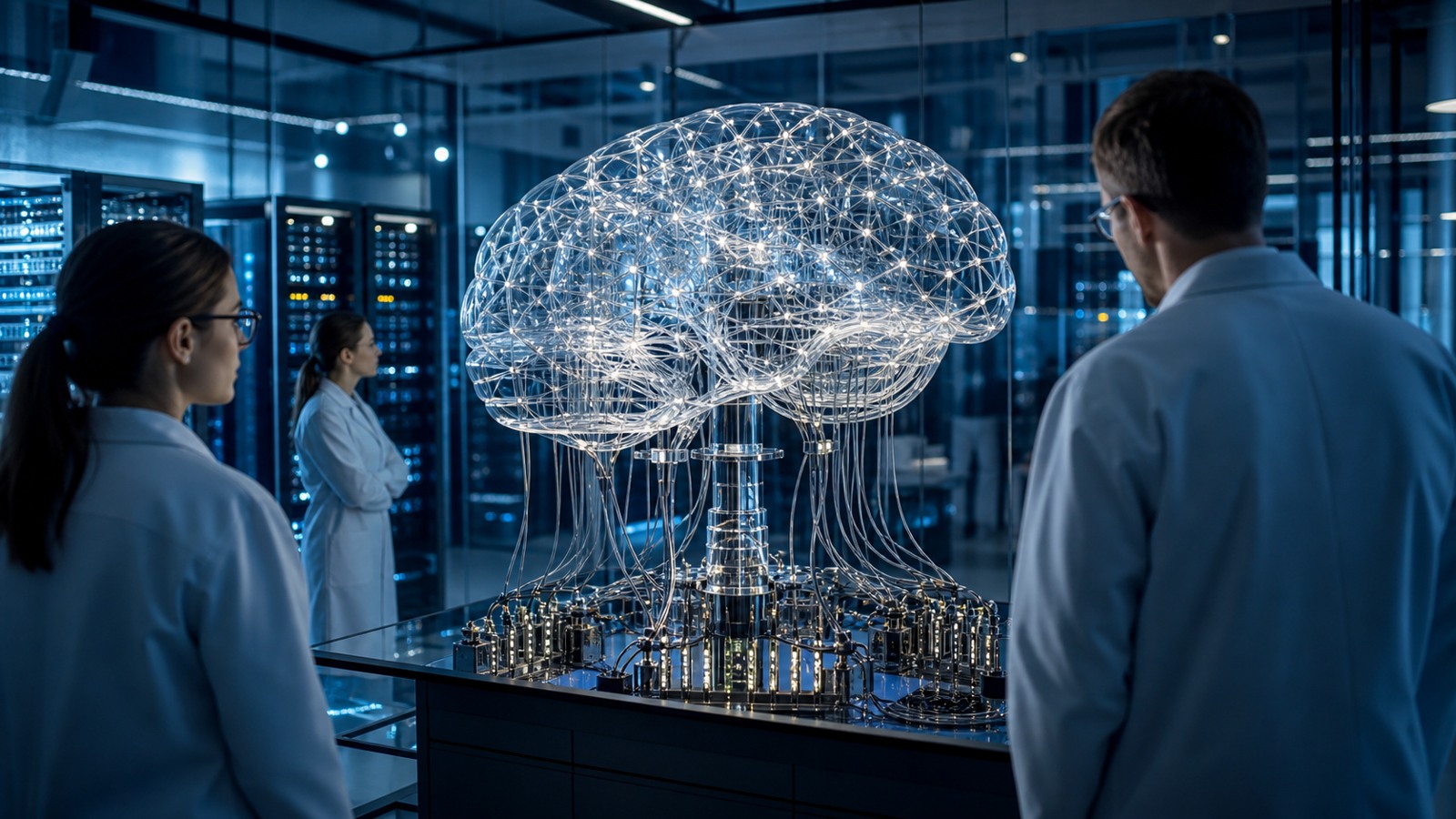
Neural Networks Turned Learning Into Computation
Neural networks are one of the core ideas behind modern artificial intelligence, but they did not arrive fully formed. They began as simple mathematical attempts to imitate how learning might happen, faded during periods of disappointment, and returned when better data, faster computers, and stronger training methods finally caught up with the idea. The path from perceptrons to modern AI is not just a timeline of inventions. It is a story about what happens when a simple learning rule becomes powerful enough to recognize images, translate language, generate text, guide robots, and reshape software.
A: It is a learning system made of connected mathematical units that adjust themselves from examples.
A: They showed that machines could learn weighted patterns, even though their limits pushed researchers toward deeper networks.
A: Backpropagation gave researchers a practical way to train many layers by tracing errors backward.
A: GPUs made the repeated calculations of deep learning much faster and more affordable.
A: They are loosely inspired by brains, but they are mathematical systems rather than biological minds.
A: Transformers handle relationships across long inputs efficiently, which made modern language AI scale.
A: They can model patterns of meaning very well, but understanding depends on grounding, context, and use.
A: It is a large model trained broadly so it can be adapted to many tasks.
A: They learn from data and objectives, so gaps, bias, and weak context can lead them astray.
A: Neural networks are powerful pattern learners, not magic, and their value depends on careful training and oversight.
The Perceptron Era
The perceptron was one of the earliest practical symbols of machine learning. It took inputs, weighted them, and produced a decision. That sounds simple because it was simple, but the idea was radical for its time. Instead of writing every rule by hand, researchers could imagine a machine that adjusted its own internal settings from examples.
The excitement around perceptrons came from a real insight: learning could be represented mathematically. If a system made a wrong prediction, the weights could be changed. If it saw enough examples, it could improve. Early demonstrations suggested that computers might eventually recognize letters, shapes, and patterns in ways that resembled perception.
The limits appeared quickly. Single-layer perceptrons could not solve many problems that required combinations of features. They lacked hidden layers that could build intermediate representations. When those limits became widely discussed, enthusiasm cooled. Yet the core idea survived: intelligence might emerge from many small adjustable connections working together.
Why Neural Networks Went Quiet
Neural networks did not disappear because the idea was foolish. They went quiet because the surrounding conditions were not ready. Computers were slow, datasets were small, and training deeper systems was difficult. Other AI approaches, especially symbolic systems based on logic and rules, looked more practical for a time.
This period of disappointment is important because it shows how technology often advances. A good idea can arrive before the tools needed to make it useful. Neural networks needed better algorithms, more data, and more computation. Without those ingredients, they could not fulfill the promises made around them. The quieter years also forced researchers to become more precise about what neural networks could and could not do. That discipline mattered later because the revival was not built only on enthusiasm. It was built on better evidence, clearer benchmarks, and a more realistic sense of what learning systems require.
Backpropagation Reopened the Door
Backpropagation changed the story by making layered learning practical. In a neural network with hidden layers, an error at the output must somehow influence earlier connections. Backpropagation provided a way to calculate those influences. It allowed networks to adjust internal layers so they could learn more complex representations.
The breakthrough was not only mathematical. It gave researchers a repeatable training method. A model could make a prediction, compare it with the correct answer, calculate the error, and update its weights. Repeating that cycle across many examples gave neural networks a path from raw input to useful behavior.
Backpropagation did not solve everything. Training could still be unstable, slow, or data-hungry. But it gave the field a foundation. Later advances in optimization, activation functions, initialization, and hardware made the method more powerful. The quiet idea from the perceptron era began to look alive again. Just as important, backpropagation changed how researchers thought about representation. Hidden layers were no longer mysterious spaces that were impossible to train; they became places where useful features could be discovered from data. That made the network feel less like a fixed machine and more like a system that could organize information internally.
Deep Learning and the Data Explosion
Deep learning became possible when networks with many layers could be trained effectively. Those layers allowed models to build representations step by step. In image recognition, early layers might detect edges, later layers might detect shapes, and deeper layers might respond to objects. The model did not need every feature hand-designed by a programmer.
Data made this approach valuable. As the internet, sensors, phones, and digital platforms produced more examples, neural networks had more material to learn from. Large labeled datasets helped computer vision systems improve dramatically. Speech recognition, translation, and recommendation systems also benefited from the same pattern: more data, better models, faster hardware. The quality of those examples mattered as much as the count. A dataset with consistent labels, broad coverage, and realistic edge cases could teach a network more than a larger collection full of noise. That is why data preparation became a serious engineering discipline rather than clerical cleanup.
GPUs were another turning point. Neural network training involves enormous numbers of similar calculations, and GPUs are good at parallel computation. Once researchers could train larger models faster, experimentation accelerated. The field moved from careful small demonstrations to systems that could beat older methods across major benchmarks.
The data explosion also changed the kind of questions researchers could ask. Instead of testing whether a model could solve a tiny academic task, teams could ask whether it could handle messy images, noisy speech, large vocabularies, and real user behavior. That shift made neural networks more practical, but it also made data quality more important. A model trained on broad data can become broadly useful, yet it can also inherit the blind spots and distortions inside that data.
Convolution, Recurrence, and Attention
Different neural network architectures emerged because different problems have different shapes. Convolutional neural networks helped vision systems by preserving local relationships in images. They were not just bigger networks; they were networks with a structure suited to visual data. That design choice helped AI see more effectively.
Recurrent neural networks were built for sequences, such as speech and text. They processed information over time, which made them useful for language tasks before newer approaches became dominant. They also revealed a recurring theme in AI history: architecture matters because it shapes what the model can easily represent.
Attention mechanisms took that idea further. Instead of processing every part of an input with the same weight, attention let models emphasize relevant relationships. Transformers used attention at scale, and that helped produce the modern wave of language models. The rise of transformers did not erase earlier architectures, but it changed the center of gravity. It also made context feel more fluid. A model could compare words, sentences, code tokens, or image patches against one another in ways that supported translation, summarization, search, and generation. That ability to relate distant pieces of information is one reason modern systems can appear more flexible than earlier neural models.
Foundation Models and Modern AI
Modern AI systems often begin as large foundation models. These models are trained on broad data and then adapted to many uses. A single model might summarize text, answer questions, write code, generate ideas, analyze images, or call tools. That flexibility is one reason neural networks now feel so different from older software.
The change is not only size. Foundation models learn representations that can transfer across tasks. They can respond to instructions, combine concepts, and produce outputs that feel surprisingly general. When connected to retrieval systems, tools, memory, and human review, they become part of larger AI workflows. This is why a modern AI product is rarely just a model sitting alone. It may include search, access controls, prompt design, logging, evaluation suites, and escalation paths. The neural network supplies capability, but the surrounding system determines whether that capability becomes useful software.
This flexibility also creates new risks. A model that can do many things can fail in many ways. It may hallucinate, inherit bias, misunderstand context, or produce output that sounds better than it is. The same architecture that makes modern AI powerful also makes careful evaluation essential.
Foundation models also changed who can build with AI. Earlier neural systems often required specialized data science teams and narrow training pipelines. Modern models can be adapted through prompts, fine-tuning, retrieval, and tool connections. That does not make AI development effortless, but it does move more experimentation into the hands of product teams, researchers, educators, and independent builders.
Why Neural Networks Still Need Humans
Neural networks learn patterns, but people define purposes. A model can optimize a loss function without knowing whether the result serves a human goal. That is why teams still need domain experts, reviewers, designers, and users involved in AI systems. The network is a tool inside a social and operational context.
Humans also help decide what data should be used, what errors matter most, and what tradeoffs are acceptable. In healthcare, a false negative may be more serious than a false positive. In creative work, novelty may matter more than consistency. In safety systems, confidence must be earned through testing. The model cannot decide those values alone. Even when a network performs well on a benchmark, people still need to ask whether the benchmark matches the real job. A chatbot that scores well on general questions may still fail inside a legal, medical, or industrial workflow where missing one detail changes the outcome.
The Next Stage of Neural Networks
The next stage of neural networks will likely involve more multimodal learning, better reasoning tools, more efficient training, and stronger links to the physical world. Models are already moving beyond text into images, audio, video, robotics, and scientific data. The boundaries between neural networks and broader AI systems are becoming less clear.
Efficiency will matter as much as scale. Training and running large models requires hardware, energy, and money. Researchers are exploring smaller models, specialized chips, sparse architectures, and better data strategies. The future may not belong only to the biggest model, but to the system that uses capability most effectively.
The history from perceptrons to modern AI teaches a useful lesson. Neural networks advance when ideas, data, hardware, and evaluation mature together. Each breakthrough solves one constraint and reveals another. That is why the field remains exciting: the core idea is old, but its possibilities are still unfolding. The next improvements may feel less dramatic than the jump to large language models, yet they could be just as important. Better reliability, lower cost, clearer explanations, and stronger domain adaptation can make AI more valuable in everyday work than raw size alone.
What Beginners Should Take Away
A neural network is best understood as a learning machine that builds internal representations from examples. It is not a brain in the human sense, and it is not a simple rule book. It sits somewhere more interesting: a mathematical structure that can discover patterns too complex for manual programming.
The journey from perceptrons to modern AI shows why patience matters in technology. Ideas can fail early and later return stronger. Breakthroughs can depend on tools that do not exist yet. Today's AI boom is built on decades of attempts, disappointments, and refinements.
For beginners, the key is to see both the power and the limits. Neural networks can recognize, generate, predict, and assist at remarkable scale. They can also be brittle, biased, opaque, and wrong. Understanding that balance is the first step toward using modern AI wisely.
That balance is also what makes the history useful. Neural networks did not become important because one invention solved intelligence forever. They became important because many improvements compounded over time: better learning rules, richer data, stronger hardware, more thoughtful architectures, and more demanding evaluation. Modern AI is the result of that accumulation, and its next stage will likely depend on the same pattern.