Deep Space Makes Autonomy Essential
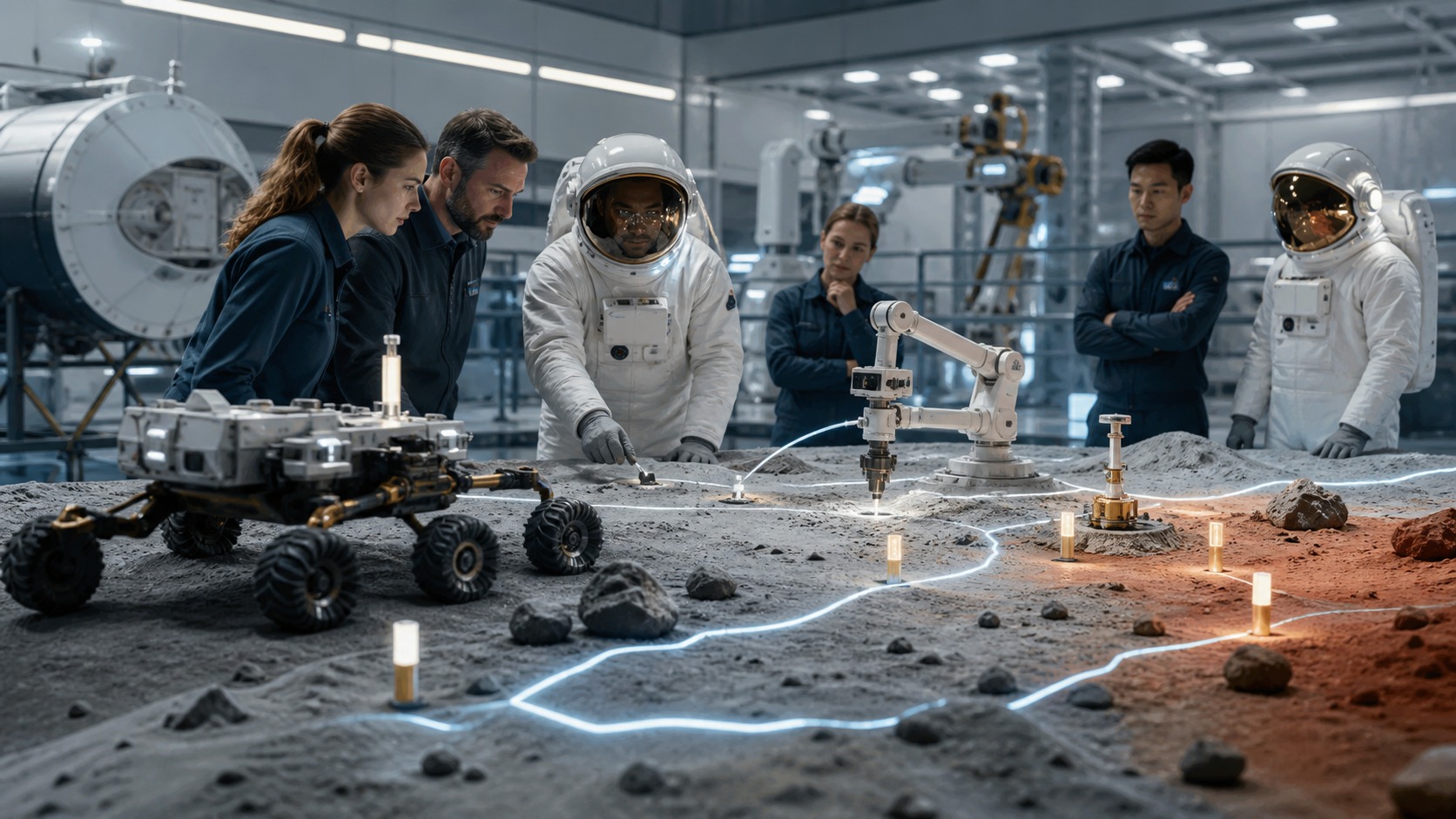
AI is helping humans return to the Moon and prepare for Mars because space missions cannot rely on constant real-time human control. Distance, danger, communication delays, harsh terrain, limited supplies, and complex science goals all make autonomy valuable. On the Moon, AI can help rovers navigate shadowed regions, prioritize samples, monitor equipment, and support crews working in demanding conditions. For Mars, the need becomes even stronger because signals take minutes to travel each way. The farther humans go, the more mission systems must sense, plan, adapt, and recover without waiting for step-by-step instructions from Earth.
A: It is about using AI to improve analysis, generation, automation, search, and decision support while keeping review and context in place.
A: No. Outputs need testing, source checks, and human judgment.
A: Common risks include inaccuracy, bias, privacy exposure, and overreliance.
A: The most important data is the data that matches the real task and user decision.
A: No. Prompts help, but data quality, tool design, and review matter too.
A: Humans should stay involved when outcomes affect people, money, safety, privacy, or trust.
A: Test outputs against real examples, track errors, and measure whether the workflow improves.
A: Yes. Fluency is not proof of accuracy.
A: Clear goals, good data, review points, monitoring, and a fallback plan.
A: Accountability stays with people who verify, govern, and apply the result.
Moon And Mars Missions Need More Local Intelligence
Human spaceflight has always depended on careful planning from Earth, but future lunar and Mars missions will require more decisions to happen locally. The Moon is close enough for communication to be manageable, yet crews still face dangerous terrain, limited oxygen, dust, radiation, and demanding timelines. Mars is far harder because messages can take many minutes to travel each way. A rover cannot ask Earth about every rock, and a crew cannot wait for ground control during every urgent system warning.
AI helps by giving mission hardware more local intelligence. A rover can assess terrain, a habitat can monitor its own systems, and a crew assistant can help astronauts retrieve procedures while their hands are occupied. None of this removes human leadership. It changes the balance between preplanned instruction and adaptive support.
That balance is essential because exploration is uncertain by definition. The most valuable discovery may be something no one expected. The safest route may change after dust, shadow, or wheel slip. A habitat component may fail slowly before alarms become obvious. AI can help missions respond to these changing conditions faster than a purely scripted system.
The Moon becomes a proving ground. Technologies tested there can teach engineers what autonomy needs before longer Mars missions depend on it. Every lunar rover, habitat, lander, and surface operation can produce lessons about how humans and intelligent machines should work together beyond Earth.
Rovers Are Becoming Smarter Field Scientists
Rovers are one of the clearest examples of AI in exploration. A rover has to move through unfamiliar terrain without tipping, getting stuck, wasting energy, or missing scientifically valuable targets. Traditional command sequences are carefully planned, but autonomy allows the vehicle to make more local choices. It can adjust a route, avoid hazards, or decide that a certain feature deserves closer inspection.
Computer vision helps rovers classify rocks, slopes, craters, shadows, and soil textures. Path planning helps them compare routes by safety, distance, power, and science value. Sensor fusion combines images, wheel feedback, inertial data, and maps into a more reliable picture of the surface. These capabilities matter because a single poor route choice can endanger equipment worth years of work.
AI can also help with science triage. Space missions face bandwidth and time limits. A rover may collect more raw data than it can immediately send home. Models can prioritize unusual features, compress routine observations, and flag promising samples. Scientists still interpret the findings, but AI can help decide what deserves attention first.
Habitats Need AI That Notices Weak Signals
A lunar or Martian habitat is a life-support system, workshop, shelter, laboratory, and power-management problem all at once. Air pressure, oxygen, carbon dioxide, humidity, water recycling, waste handling, power storage, thermal control, and radiation exposure all matter. Many failures begin as subtle changes before they become emergencies. AI can monitor patterns continuously and warn crews when something looks wrong.
Predictive maintenance becomes crucial because spare parts are limited. A pump that vibrates slightly differently, a seal that loses performance, or a battery that behaves oddly under temperature swings may need attention before it fails. On Earth, replacement can be inconvenient. On Mars, replacement may be impossible until the next supply window.
Crew health is part of the same system. AI may help monitor sleep, workload, stress, injury risk, and radiation exposure. The goal is not to surveil astronauts for its own sake; it is to protect people living in an extreme environment where small problems can cascade. Any health system would need strong privacy, trust, and clear medical oversight.
The habitat AI also has to explain itself. An astronaut needs to know whether a warning is urgent, uncertain, or routine. A black-box alarm that constantly interrupts the crew will lose trust. A useful system gives concise reasons, suggested actions, and a path to deeper detail when needed.
This kind of AI may not look glamorous. It may simply keep air, water, heat, and power stable while the crew focuses on exploration. In deep space, that quiet reliability is heroic.
AI Can Reduce Crew Cognitive Load
Astronauts operate under pressure. They follow procedures, maintain equipment, conduct experiments, communicate with Earth, exercise, manage risk, and respond to surprises. AI assistants can reduce cognitive load by retrieving the right procedure, summarizing system status, translating sensor warnings into priorities, and helping schedule tasks around power, sunlight, and crew fatigue.
A useful assistant has to be grounded in approved mission knowledge. It cannot improvise unsafe instructions or invent missing details. It should cite source procedures, know when to say it is uncertain, and escalate to human specialists when needed. In space, a confident hallucination is not merely embarrassing. It can be dangerous.
Preparing For Mars Means Planning For Delay
Mars missions force autonomy because Earth is too far away for immediate guidance. A crew dealing with a habitat issue may have to act before a response from Earth arrives. A rover exploring beyond direct crew supervision may need to make route and science choices on its own. A power system may need to balance supply and demand during dust or equipment stress without waiting for ground control.
AI can help mission planners simulate these conditions before launch. Digital twins can test habitats, rovers, schedules, and emergency procedures. Simulations can expose where autonomy is safe, where human approval is required, and where systems need better fallback behavior. The point is not to create fearless machines. It is to create cautious systems that understand their boundaries.
Mars also requires more local manufacturing, repair, and resource use. AI may help manage 3D-printed parts, robotic construction, soil processing, water extraction, and habitat expansion. These are not science-fiction extras. They are practical responses to distance. The more a mission can diagnose, repair, and adapt locally, the less vulnerable it is to supply delays.
The human role becomes more strategic. Astronauts will still explore, decide, improvise, and take responsibility. AI will handle more monitoring, triage, planning support, and repetitive robotic work. That partnership may be the difference between a mission that merely survives and one that keeps discovering.
Science Selection Is A Hidden AI Opportunity
Exploration missions are full of tradeoffs between safety, time, energy, and scientific value. A crew may have only a short window to collect samples before lighting changes, equipment cools, or a return route becomes risky. AI can help rank targets by novelty, geological importance, accessibility, and relationship to mission goals. That does not replace scientists; it gives them a sharper short list when time is scarce.
Autonomous science tools can also notice patterns humans might miss during a demanding field operation. A rover may compare mineral signatures, surface textures, and prior observations to flag an unusual target. A habitat lab may prioritize which samples need immediate preservation. On Mars, where sending everything home is impossible, intelligent triage becomes part of discovery itself.
Trustworthy Space AI Must Be Conservative
Space AI should be designed with humility. A system that is too adventurous can damage equipment, waste irreplaceable energy, or put a crew in danger. Conservative autonomy means the AI understands when to stop, when to request human review, and when the safest action is to preserve options. Success may look like a rover pausing before a hazardous slope or a habitat assistant refusing to simplify a critical procedure.
Explainability matters more in space than in many everyday settings. If an AI recommends skipping a route, delaying a task, or replacing a component, astronauts and ground teams need enough reason to trust or override the advice. The system should expose the evidence behind its recommendation in mission language, not technical mystery.
Reliability also depends on testing across ugly conditions. Dust, radiation, low light, unusual shadows, thermal stress, and mechanical wear can all confuse sensors and models. AI that works in a clean lab still has to prove itself in the harsh, partial, noisy reality of another world.
The Future Of Exploration Is Human And Machine Together
AI will not replace astronauts. It will extend what they can safely do. It can scout terrain before a spacewalk, monitor life support while the crew sleeps, help scientists choose samples, and keep robots productive when Earth is out of the loop. The most important systems will be reliable, explainable, conservative, and deeply tested.
Returning to the Moon and preparing for Mars is not only a rocket challenge. It is a decision challenge. Missions will involve too much data, too much uncertainty, and too little time for every choice to be made from Earth. AI gives explorers more local capacity, but it must be designed around human goals and mission safety.
The next era of space exploration will be defined by partnership. Humans bring curiosity, courage, ethics, and scientific judgment. AI brings tireless monitoring, rapid comparison, autonomous movement, and pattern detection. Together, they can make deep-space missions more resilient than either could be alone.
That partnership will probably mature in stages. First, AI will support analysis, navigation, inspection, and scheduling. Then it will take on more autonomous fieldwork in carefully bounded settings. Eventually, crews may rely on intelligent systems as everyday mission companions, not because the machines are in charge, but because survival and discovery require more local capability than humans can carry alone.
The Moon is where many of those habits can be learned. Engineers can test rover autonomy, habitat monitoring, crew assistants, and robotic construction close enough to Earth for rapid correction. Mars will demand the lessons. By the time humans live and work there, AI should already have proven that it can be cautious, useful, and understandable under pressure.
The dream of returning to the Moon and reaching Mars is still human. AI simply helps make that dream more practical. It gives explorers more eyes, more patience, more pattern recognition, and more ways to recover when the environment refuses to cooperate.
That practical support may be what makes the next era different from the first space age. Earlier missions depended on extraordinary crews and massive ground support. Future missions will still need both, but they will also need machines that can help locally when Earth is distant, the clock is tight, and the terrain is unknown.
That is the quiet promise of AI in space: not replacing exploration, but making explorers less alone when distance turns every delay into a design constraint. The farther humans travel, the more valuable that local intelligence becomes for safety, science, repair, and daily survival. It becomes part of mission resilience, especially when crews must act before Earth can answer.