Space Is a Natural Home for Practical AI
AI is transforming space exploration because space is remote, dangerous, data-rich, and full of delay. A rover on Mars cannot wait for instant human steering. A satellite can collect more imagery than analysts can review by hand. A spacecraft traveling far from Earth needs to make careful decisions when communication is slow or limited. Artificial intelligence helps missions detect hazards, prioritize science, plan movements, analyze signals, and operate with more independence while human teams stay focused on strategy, safety, and discovery.
A: Space missions face delay, danger, and huge data volumes, so autonomy and analysis are valuable.
A: AI can support navigation and analysis, but mission-critical control still depends on engineered safeguards and human oversight.
A: It helps rovers prioritize images, navigate terrain, detect hazards, and conserve limited communication time.
A: Satellites collect massive data streams that AI can filter, classify, and prioritize.
A: It means analyzing data onboard before sending only the most useful results to Earth.
A: AI can help identify candidate signals, but scientists must validate the evidence.
A: Hardware limits, radiation, power constraints, and communication delays raise the reliability bar.
A: AI may support astronauts and robotic missions, but human exploration still has unique value.
A: A model can make a costly recommendation from incomplete sensor data if mission teams do not define review limits.
A: Space missions will use more onboard intelligence while keeping humans responsible for goals.
Why Space Missions Need Autonomy
Space exploration is a communication problem as much as an engineering problem. Signals take time to travel, and the delay grows with distance. A rover on Mars may wait many minutes for a command and many more minutes for confirmation. For deep-space probes, the delay can become hours. That makes constant human control impractical.
Distance also changes the cost of missed opportunities. A dust devil, unusual rock layer, short-lived plume, or brief alignment may appear while a spacecraft is waiting for instructions. If the system can recognize that an event is worth attention, it can preserve data that might otherwise be lost. In exploration, autonomy is often the difference between noticing something and passing it by.
Autonomy lets spacecraft and robots handle local decisions within limits. A rover can avoid a hazard, choose a safer path, or pause when sensors disagree. A satellite can prioritize which images to transmit. A probe can respond to a fault before mission control receives the first warning.
This does not remove people from exploration. It changes their role. Humans define mission goals, science priorities, acceptable risks, and operating rules. AI helps execute those choices in places where waiting for every instruction would waste time or create danger.
That partnership is important because space missions are built around trust. Engineers need to trust the spacecraft enough to let it act, but not so much that they surrender judgment. Scientists need AI to surface possibilities without hiding uncertainty. The best mission designs make autonomy legible, so people can see not only what the system did but why it chose that action.
Rovers Are Becoming More Capable Field Scientists
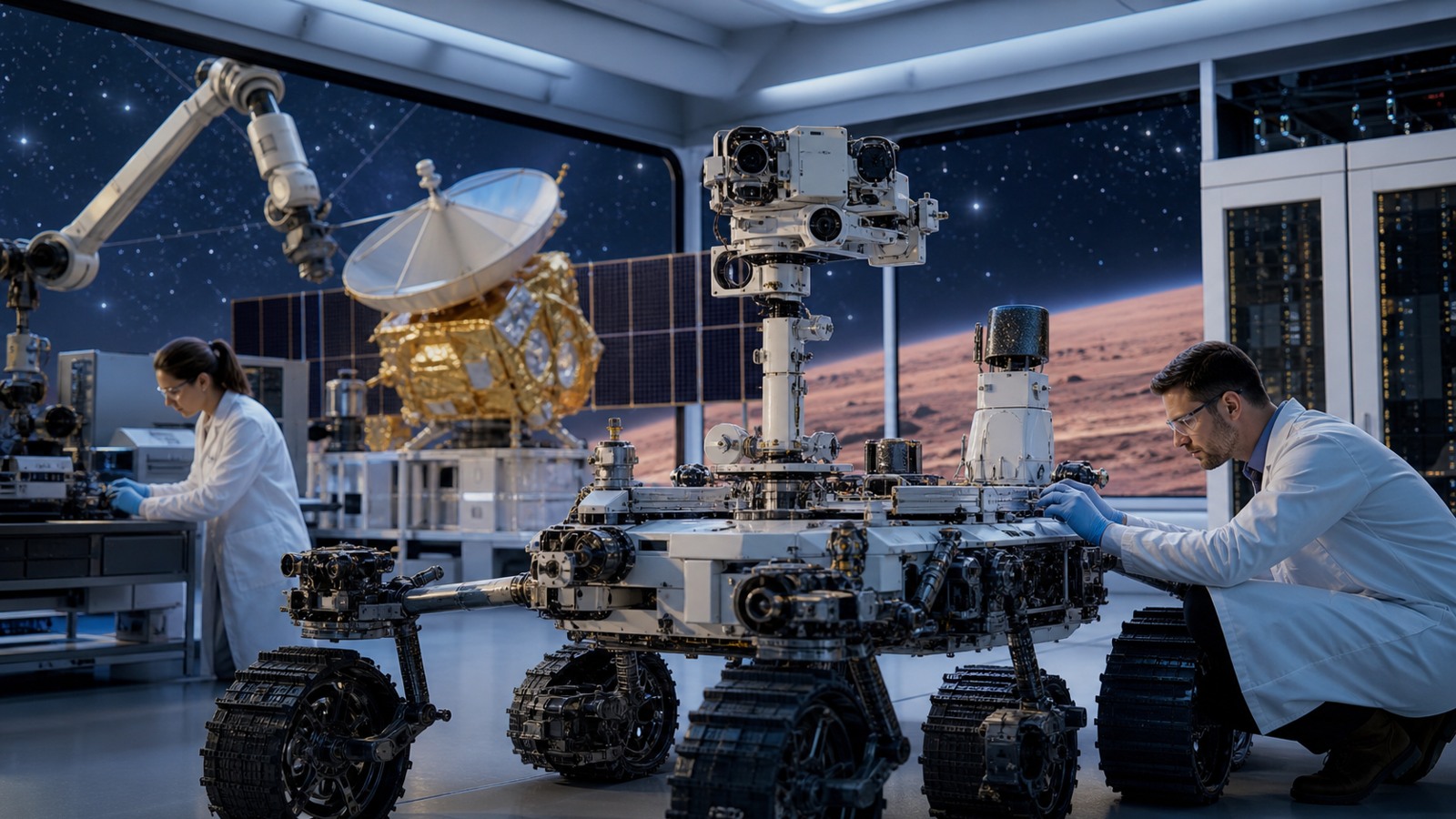
Planetary rovers are one of the clearest examples of AI in space. They must move across unknown terrain, manage limited energy, protect delicate instruments, and choose which observations are worth the effort. Every meter can matter when the mission budget is measured in years and the environment is hostile.
Computer vision helps rovers understand terrain. A system can detect rocks, slopes, soft soil, and obstacles, then compare possible routes. Autonomy allows the rover to continue making progress when a human-planned path needs adjustment. That saves mission days and reduces the risk of getting stuck.
AI can also support science decisions. A rover may use onboard analysis to identify unusual textures, minerals, or formations. It can flag targets that deserve closer inspection instead of sending every raw observation back to Earth. Human scientists still make the deeper interpretation, but AI helps them spend attention where it matters most.
This is especially valuable because every rover activity has an opportunity cost. Time spent driving cannot also be spent drilling. Energy spent on one observation may limit another. A camera angle chosen today may determine whether a team understands a formation tomorrow. AI helps mission teams manage these tradeoffs by ranking options under real constraints.
Future rovers may act more like patient field assistants. They could notice that a terrain feature resembles something seen weeks earlier, propose a short detour, or take extra measurements before a communication window closes. The human team would still decide the scientific story, but the robot would help preserve possibilities.
Rover autonomy also helps teams manage uncertainty in the terrain itself. Orbital maps can guide a route, but they cannot show every loose rock, wheel hazard, or subtle slope. Local perception lets the rover update the plan as the ground reveals itself.
Satellites Turn AI Into an Earth-Scale Sensor
Satellites create a flood of imagery and measurements. They monitor weather, oceans, forests, cities, farms, ice, pollution, disasters, and military activity. The challenge is not only collecting data. It is finding meaningful change quickly enough for people to act.
AI helps by detecting patterns in imagery. It can identify flood boundaries, wildfire smoke, damaged roads, illegal deforestation, crop stress, or ships at sea. It can compare new images with older ones and highlight what changed. This kind of analysis can support emergency response, climate research, logistics, and public planning.
The same capability creates responsibility. Satellite AI can affect privacy, security, and geopolitical decisions. A model that misclassifies a structure or misses a disaster zone can lead people in the wrong direction. Analysts need validation, uncertainty estimates, and a clear understanding of what the model was trained to recognize.
Onboard AI can also reduce the pressure on communication networks. Instead of sending every image, a satellite may identify cloud cover, detect a relevant change, compress the most important region, and transmit a prioritized result. That matters as satellite constellations grow. The more sensors humanity places in orbit, the more important intelligent triage becomes.
AI Helps Scientists Search the Universe
Space science produces datasets too large for manual review. Telescopes survey the sky, instruments record spectra, and simulations produce huge models of cosmic behavior. AI can help scientists search these archives for rare events, unusual objects, and faint signals hidden in noise.
Exoplanet discovery is a good example. Machine learning can help identify small dips in starlight that may indicate a planet crossing in front of a star. It can reduce candidate lists so researchers can focus on the most promising signals. Similar techniques can support galaxy classification, asteroid detection, solar storm forecasting, and gravitational-wave analysis.
Still, science needs evidence, not just predictions. AI-generated candidates must be checked against instruments, physics, and alternative explanations. The best discovery systems act like tireless assistants: they sort, flag, compare, and suggest, while scientists test what the signals actually mean.
This human review is not a weakness in AI science. It is how science protects itself. A rare astronomical signal may be an instrument artifact, a data processing error, or a known object seen from a new angle. AI can widen the search, but scientific confidence still comes from replication, theory, and careful elimination of simpler explanations.
The payoff is that scientists can ask broader questions. Instead of manually inspecting a small sample, they can search across years of observations and many instruments. AI does not replace curiosity; it gives curiosity a larger map and helps researchers decide where careful human attention should go next, especially when rare signals are easy to overlook.
Mission Planning Is a Giant Constraint Puzzle
Every mission is constrained by time, power, temperature, orbital mechanics, instrument availability, communication windows, and risk. Planning a day of rover activity or a satellite observation schedule can involve many competing goals. AI can help compare options and reveal plans that humans might not find quickly.
This kind of AI does not need to be glamorous to be valuable. A scheduling tool that saves power, avoids conflicts, and increases science time can improve a mission more than a flashy robot demonstration. Space exploration rewards reliability, and reliable planning is one of the quiet places where AI can shine.
Planning also becomes harder as missions involve more moving parts. A lunar base, Mars sample campaign, or coordinated telescope network may require many assets to share time, power, and communication windows. AI can help mission teams simulate options before committing to them. It can reveal bottlenecks early, when a plan can still be changed.
Reliability Matters More Than Hype
Space is unforgiving. A software mistake can waste a rare observation, damage equipment, or end a mission. Hardware may be old by the time it reaches its destination. Radiation can affect electronics. Power is limited. Repair is usually impossible. These conditions make AI reliability far more important than novelty.
That is why space AI tends to be carefully bounded. A system may be allowed to choose among approved routes, but not to ignore safety rules. It may prioritize images, but not throw away critical engineering data. It may diagnose anomalies, but still require confirmation before risky action. Autonomy is useful because it is constrained.
Testing is also difficult. Engineers can simulate many conditions, but they cannot perfectly recreate another planet, a distant moon, or a decade-long journey. Space AI must be designed with uncertainty in mind. It needs fallbacks, conservative behavior, and clear ways to explain why it acted.
The reliability culture of spaceflight can teach the broader AI field something useful. Not every system should chase maximum autonomy. Sometimes the best design is a narrow autonomous function that performs one job extremely well, reports its reasoning clearly, and hands control back when conditions move outside its envelope.
Astronauts and AI Assistants
AI may also support human crews. Astronauts work in complex environments where time, attention, and safety are limited. An onboard assistant could summarize procedures, monitor equipment, translate sensor data, help schedule tasks, or guide troubleshooting when communication with Earth is delayed.
The assistant role is different from command. Crews need systems they can question, override, and understand. A confident answer is not enough when lives and mission hardware are at stake. The AI must support situational awareness rather than creating another source of confusion.
As missions move toward the Moon, Mars, and longer-duration habitats, local intelligence will become more valuable. Crews farther from Earth will need more autonomy, and AI can help them manage routine complexity. The human role remains central because exploration is not only about efficiency. It is about judgment, courage, and purpose.
AI assistants may also help reduce cognitive load during emergencies. A crew dealing with a leak, medical event, or equipment fault may need quick access to procedures and system status. An assistant that can gather context and present options clearly could buy precious time. The key is that it must support decision-making without pretending to be mission commander.
Crew support also includes ordinary work. Long missions involve maintenance, inventory, exercise, research, communication, and psychological strain. AI systems that quietly organize routines and surface anomalies could make exploration more sustainable. The value may come from reducing friction every day rather than solving one spectacular crisis.
The Future of Exploration Will Be Shared
The future of AI in space is likely to be a partnership between human mission teams, autonomous spacecraft, robotic explorers, and intelligent analysis tools. More decisions will happen onboard. More data will be filtered at the edge. More scientific leads will come from models searching enormous archives.
That future will not make exploration easy. It will make new kinds of missions possible. Swarms of small satellites could coordinate observations. Rovers could travel farther between commands. Probes could respond to unexpected events. Scientists could search the universe with tools that expand their attention.
AI is transforming the final frontier because space demands intelligence where humans cannot always be present. The best systems will not replace explorers. They will extend human reach into places where distance, danger, and complexity once made discovery too slow or too risky.
That extension of reach is the real promise. AI can help humanity look more carefully, travel more safely, and use scarce mission resources more wisely. The final frontier will still require human imagination, but intelligent machines will increasingly carry that imagination into environments where people cannot yet go.