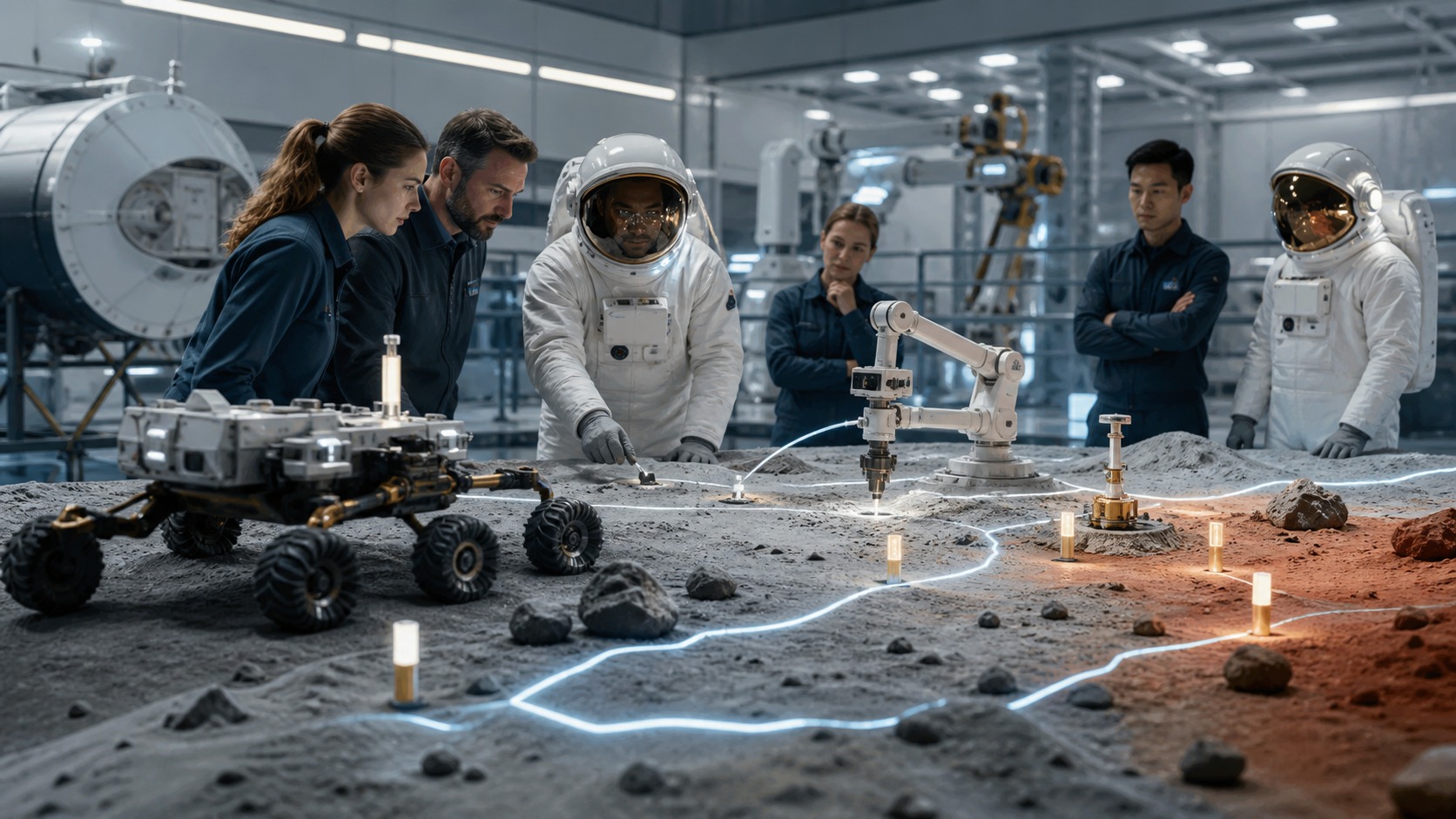
A New Technological Revolution Is Accelerating
Artificial intelligence has already shifted from an experimental field into one of the most powerful engines of modern innovation. It now shapes how people search for information, create digital content, analyze data, diagnose diseases, manage logistics, and interact with software every day. Yet the AI systems that have captured headlines so far may only represent the beginning. A much larger transformation is unfolding as researchers, startups, global enterprises, and public institutions push artificial intelligence into deeper and more ambitious territory. What makes this moment so important is that AI is no longer evolving in a single direction. Instead, it is advancing across hardware, software, robotics, language, perception, autonomy, and scientific research all at once. The result is a rapidly growing ecosystem of intelligent technologies that can generate ideas, interpret the real world, optimize complex systems, and collaborate with people in increasingly sophisticated ways. These breakthroughs are not just making current tools more efficient. They are opening entirely new categories of products, services, and capabilities. The future of AI will be defined by the technologies that expand machine intelligence beyond narrow tasks and into richer forms of decision-making, creativity, adaptability, and real-world action. Some of these technologies are already entering mainstream business use. Others are still emerging from research labs but show enormous potential to reshape industries and daily life. Together, they reveal how the next era of artificial intelligence could transform the world.
A: It is about using AI to improve analysis, generation, automation, search, and decision support while keeping review and context in place.
A: No. Outputs need testing, source checks, and human judgment.
A: Common risks include inaccuracy, bias, privacy exposure, and overreliance.
A: The most important data is the data that matches the real task and user decision.
A: No. Prompts help, but data quality, tool design, and review matter too.
A: Humans should stay involved when outcomes affect people, money, safety, privacy, or trust.
A: Test outputs against real examples, track errors, and measure whether the workflow improves.
A: Yes. Fluency is not proof of accuracy.
A: Clear goals, good data, review points, monitoring, and a fallback plan.
A: Accountability stays with people who verify, govern, and apply the result.
Generative AI Is Redefining Creativity and Productivity
Generative AI has become one of the most visible and influential breakthroughs in modern computing. Unlike older AI tools designed mainly to classify information or identify patterns, generative systems can create entirely new outputs. They can draft written content, generate images, summarize reports, compose music, produce code, and assist with brainstorming in ways that feel surprisingly flexible and interactive.
This matters because it changes the relationship between people and software. Instead of simply clicking through menus or filling in rigid forms, users can now describe what they need and receive a customized response in seconds. That shift is transforming content creation, software development, design workflows, research, and customer support. Businesses are using generative AI to accelerate tasks that once required far more time, while creators are using it to explore new concepts and scale ideas more quickly.
The most important long-term effect of generative AI may be its role as a creative partner rather than just an automation tool. It can help humans move from blank-page uncertainty to early momentum, allowing professionals to focus more attention on judgment, refinement, and strategy. As these systems become more specialized and reliable, they will likely become a standard layer across many digital workflows.
Multimodal AI Gives Machines a Richer Understanding of Reality
One of the most exciting breakthroughs in artificial intelligence is multimodal AI, which allows systems to work across multiple types of information at the same time. Traditional AI models often focused on a single domain, such as text, speech, or images. Multimodal systems can combine several of these at once, enabling more holistic understanding and more natural interactions. This is a major leap because the real world is not divided neatly into isolated data types. Human beings speak, read, observe, listen, and respond in a continuous stream of mixed information. AI becomes much more useful when it can operate in a similarly integrated way. A multimodal system might read a document, analyze an image, understand spoken instructions, and then generate a response that reflects the whole context rather than a single input channel.
This technology has broad implications for healthcare, industrial monitoring, education, accessibility, and digital assistants. In medicine, multimodal AI can combine imaging, written notes, lab results, and patient history. In manufacturing, it can interpret machine data, maintenance records, and visual inspection feeds together. The result is a more capable and context-aware form of intelligence that will power many of the next generation’s most advanced AI tools.
Edge AI Brings Intelligence Out of the Cloud
Cloud computing has played a major role in the rise of artificial intelligence, but the next wave of AI growth will increasingly happen at the edge. Edge AI refers to intelligent processing that occurs directly on local devices rather than relying entirely on distant servers or centralized data centers. This includes smartphones, industrial sensors, cameras, vehicles, drones, medical devices, and smart infrastructure.
The breakthrough here is speed and practicality. When AI runs locally, systems can make decisions in real time without the delays that come from constantly sending data back and forth over networks. That matters in environments where even short delays can create risk or reduce performance. Self-driving systems, robotic equipment, factory monitoring tools, and emergency-response technologies all benefit from faster local decision-making.
Edge AI also improves privacy and efficiency. Sensitive information can often stay on the device, and organizations can reduce network strain by processing data where it is generated. As AI chips become more powerful and energy-efficient, edge intelligence will become one of the most important forces behind smart products and responsive environments.
Autonomous Systems Are Reshaping Operations
Autonomous AI is another breakthrough technology that will transform the world, not just through self-driving vehicles but across a wide range of industries. Autonomous systems use sensors, machine learning, planning models, and continuous feedback to operate with reduced human intervention. They can interpret changing conditions, make decisions, and act in complex environments.
This technology is becoming increasingly important in logistics, agriculture, infrastructure inspection, warehousing, aviation, and energy. Autonomous drones can inspect remote assets and monitor large areas more efficiently than manual teams. Autonomous machines in agriculture can support precision planting, crop analysis, and field operations. In warehouses, intelligent systems can sort, route, and move products with greater consistency and speed. The broader significance of autonomy lies in how it improves reliability and scale. Many industries depend on repetitive coordination, physical movement, and constant monitoring. Autonomous AI makes those processes more adaptive and efficient, allowing human workers to focus more on oversight, problem-solving, and decision-making at a higher level.
Collaborative Robotics Are Changing Physical Work
Robotics has long been associated with heavy industrial automation, but AI is pushing robotics into a much more flexible and collaborative era. Today’s intelligent robots can perceive their surroundings, recognize objects, adapt to changing conditions, and work more safely around people. This shift is especially important for industries that need automation without sacrificing flexibility.
Collaborative robots, often called cobots, are designed to operate alongside human workers rather than behind safety cages on isolated assembly lines. They can assist with packaging, sorting, inspection, light manufacturing, and repetitive handling tasks. In healthcare and logistics, they can support movement, organization, and workflow efficiency in environments where precision and safety matter.
The breakthrough is not just that robots are stronger or faster. It is that they are becoming more aware and more useful in human-centered settings. As AI improves robotic perception and control, these systems will become more common in everyday commercial environments, helping businesses automate tasks that were previously too variable for traditional machines.
Large Language Models Are Transforming Communication
Large language models have changed how people interact with software by making language itself a primary interface. These models can write, revise, summarize, explain, answer questions, translate, brainstorm, and help structure information in ways that feel more natural than traditional software tools. That alone makes them one of the most transformative AI breakthroughs of the current era.
What makes language models so powerful is their broad adaptability. A single system can support customer service, research assistance, content planning, software documentation, education, search improvement, and internal business workflows. Organizations are using language models to simplify knowledge access, improve communication, and reduce the time it takes to move from question to useful output. Their long-term value will likely grow as they become more grounded in trusted sources, better at reasoning across large contexts, and more deeply integrated into workplace tools. Rather than sitting apart as novelty interfaces, language models are becoming part of the basic infrastructure of modern digital work.
AI-Powered Scientific Discovery Could Accelerate Humanity’s Progress
One of the most promising AI breakthroughs is its role in scientific discovery. Researchers are using machine learning and advanced modeling systems to analyze enormous datasets, predict molecular behavior, simulate materials, and uncover patterns that would be difficult or impossible to find manually. This changes not only the speed of research but also the scale of what scientists can explore.
In medicine, AI is helping identify potential drug candidates, detect disease signals, and model biological processes. In materials science, it can search for better combinations of compounds that may improve batteries, electronics, manufacturing, or energy storage. In climate research, it can strengthen modeling and help scientists understand highly complex environmental systems.
The significance of this technology goes far beyond productivity. It gives researchers a new kind of discovery engine that can narrow search spaces, highlight unlikely opportunities, and generate insights at extraordinary speed. Some of the most important breakthroughs of the coming decades may be powered not by AI as a consumer product, but by AI as a scientific instrument.
Computer Vision Is Giving Machines Eyes
Computer vision remains one of the most powerful AI technologies because it gives machines the ability to interpret visual information. From security systems and medical imaging to robotics and autonomous navigation, computer vision enables software and machines to understand scenes, identify objects, track motion, and detect subtle anomalies.
What makes this technology transformative is how many industries depend on visual tasks. Quality control in manufacturing, diagnostic imaging in healthcare, traffic monitoring in cities, and navigation in robotics all rely on the ability to recognize and interpret visual conditions. AI-powered vision systems can do this at speed and scale, often identifying patterns that humans might miss over long periods or across massive datasets. As cameras, sensors, and visual models improve together, computer vision will become even more central to intelligent environments. It will support safer transportation, more precise automation, stronger inspection systems, and richer digital experiences across both physical and virtual spaces.
Voice AI Is Making Human-Machine Interaction More Natural
Voice AI has advanced rapidly, turning spoken language into a much more practical and intuitive interface for everyday technology. Speech recognition, voice synthesis, and conversational systems now allow people to interact with software hands-free and in more natural ways. This is especially valuable in homes, vehicles, service environments, and professional settings where keyboards and screens are not always ideal.
The breakthrough is not just better transcription. Modern voice systems can understand tone, intent, and context more effectively than earlier generations of assistants. They can support multilingual conversations, automate service workflows, and assist users who benefit from more accessible interfaces. Voice technology is becoming an important layer in everything from smart devices to contact centers and enterprise systems.
As voice AI becomes more reliable and expressive, it will likely blend with multimodal systems to create assistants that can listen, observe, interpret, and respond fluidly. That will make technology feel less mechanical and more responsive to everyday human communication.
AI Chips and Specialized Hardware Are Powering the Revolution
Artificial intelligence would not be advancing at its current pace without hardware innovation. Specialized AI chips, accelerators, and new processing architectures are making it possible to train larger models and run intelligent systems more efficiently across cloud and edge environments. This is one of the most important but sometimes least visible breakthrough areas in AI.
Traditional processors were not designed specifically for the demands of deep learning, large-scale inference, and real-time machine intelligence. New hardware has changed that by improving parallel processing, reducing energy use, and enabling higher performance for AI-specific tasks. This affects everything from data centers and research labs to mobile devices and industrial systems. The importance of AI hardware will only grow as intelligent systems expand into more products and environments. Faster, cheaper, and more efficient hardware will determine how widely AI can scale, how affordable advanced tools become, and how much intelligence can be embedded into everyday devices.
Digital Twins and Simulation AI Are Improving Real-World Decisions
Digital twins are virtual representations of real-world systems, products, environments, or operations. When combined with artificial intelligence, they become powerful tools for analysis, prediction, and optimization. Businesses can simulate factories, supply chains, machines, buildings, or infrastructure systems and use AI to test scenarios before making costly real-world decisions.
This breakthrough has enormous practical value. A manufacturer can simulate production line changes before installing new equipment. A city can model traffic flow and infrastructure adjustments before implementation. An energy operator can test maintenance strategies or efficiency improvements on virtual assets before changing real systems.
Simulation AI reduces risk while improving planning. It allows organizations to experiment digitally, learn faster, and make more informed choices. As sensors and data collection improve, digital twins will become more detailed and more useful across industrial, urban, and environmental systems.
Personalized AI Will Tailor Technology to Individuals
Another major breakthrough is the rise of personalized AI systems that adapt to individual users rather than treating everyone the same. These systems can learn preferences, behaviors, work styles, and goals over time, creating more useful and relevant experiences. This is already beginning to influence education, ecommerce, productivity, and customer support. In learning environments, personalized AI can adjust the pace and structure of lessons based on student progress. In business software, it can prioritize the most relevant information for each employee role. In consumer experiences, it can offer recommendations that go beyond surface-level history and reflect deeper intent or context.
The real promise of personalized AI is not just convenience. It is the ability to make technology feel more intelligent in a practical, human-centered way. Systems that adapt meaningfully to users can reduce friction, improve outcomes, and make digital experiences feel more supportive rather than generic.
Explainable AI Will Become Essential for Trust
As artificial intelligence takes on bigger roles in decision-making, explainability will become increasingly important. Explainable AI focuses on making model behavior easier for people to understand, especially in high-stakes areas such as healthcare, finance, insurance, employment, and security. This technology matters because trust is not built on performance alone. It also depends on visibility and accountability.
Organizations need to know why an AI model produced a prediction or recommendation, especially when that output affects people’s lives or important operations. Better explanation tools can help teams detect bias, verify quality, improve oversight, and communicate results more clearly. This is critical for responsible deployment and long-term acceptance.
Explainable AI will likely become a defining feature of successful enterprise systems. The most influential AI tools will not just produce answers. They will also make those answers easier to evaluate and use responsibly.
Neuromorphic Computing Could Redefine Machine Intelligence
Neuromorphic computing is one of the more futuristic AI breakthroughs, but it may eventually become one of the most important. This approach designs hardware and processing architectures inspired by the human brain rather than traditional computing systems. The goal is to create machines that process information more efficiently, especially for perception, adaptation, and low-power intelligence.
The appeal of neuromorphic systems lies in their potential efficiency and flexibility. Traditional AI workloads can require enormous energy and computing resources. Brain-inspired architectures may offer new ways to process information more dynamically while reducing power consumption. That could be especially important for robotics, sensors, edge devices, and autonomous machines that need fast local intelligence. Although this field is still developing, it represents an important reminder that the future of AI is not only about bigger models. It is also about entirely new approaches to how intelligent computation works.
Human-AI Collaboration May Be the Biggest Breakthrough of All
Perhaps the most transformative AI breakthrough is not a single model, chip, or machine. It is the growing ability of humans and artificial intelligence to work together effectively. Across industries, the best results increasingly come from systems that combine machine speed with human judgment, creativity, and domain expertise.
A scientist can use AI to explore research directions faster. A designer can use it to generate concepts before refining them with human taste. A doctor can use it to surface patterns that support better diagnosis. A business team can use AI to analyze complexity at scale while people remain in charge of goals, priorities, and decisions.
This collaborative future matters because intelligence is not only about efficiency. It also includes responsibility, ethics, context, and imagination. AI becomes most powerful when it helps people think better, discover faster, and create more than they could alone. That partnership may ultimately be the force that drives the greatest transformation.
The Technologies Worth Watching Are Already Taking Shape
The next era of artificial intelligence will not arrive all at once. It is emerging through a collection of breakthrough technologies that are already changing industries, research, and daily life. Generative systems are redefining creativity. Multimodal AI is creating richer interactions. Edge intelligence is making machines faster and more responsive. Robotics, autonomy, voice systems, computer vision, and scientific AI are extending intelligence into the physical world and the frontier of discovery.
These technologies are not isolated trends. They are converging into a broader ecosystem that will shape the future of business, science, infrastructure, education, and society. The most important developments may come not from one breakthrough alone, but from how these systems work together. That is why this moment in AI feels so powerful. The tools being built now are not just improving existing workflows. They are redefining what technology can become.
Breakthrough AI Technologies That Matter Most
The most important AI breakthroughs are connected parts of a larger system. Foundation models make general-purpose language, image, audio, and code capabilities easier to reuse. Multimodal AI connects text, images, sound, and video. AI agents link models to tools and workflows. Retrieval-augmented generation grounds model answers in trusted documents. Robotics connects perception and planning to physical action.
Other major breakthroughs include AI chips, edge AI, diffusion models, synthetic data, small language models, AI coding systems, scientific-discovery tools, and evaluation platforms. Stanford’s 2026 AI Index shows fast progress in model capabilities and agent performance, but the practical impact still depends on accuracy, cost, safety, data quality, governance, and whether the system improves a real workflow.